
Share this Case Study
Global Data Transformation: Building a Unified Analytics Platform at Enterprise Scale
Executive Summary:
A leading global omni-channel brand operating in 30+ individual markets found it operationally difficult to gain a deeper understanding of its customers and optimize their lifecycle due to fragmented data systems and disparate reporting structures. To overcome these challenges, InXiteOut architected an enterprise-scale analytics platform that automated data extraction and standardized massive volumes of data into a centrally governed source of truth. By implementing a comprehensive global KPI framework, the solution successfully transitioned the organization to a self-serve analytics model. It ensured 70% faster insight delivery through 60+ interactive dashboards, supporting ~1,200 active business users.
Client Context
A leading global omni-channel brand operating in 30+ countries runs a complex digital ecosystem spanning e-commerce platforms, consumer care, loyalty, and referral programs to deliver an optimal customer experience throughout the customer lifecycle.
To effectively optimize this journey and ensure deep customer understanding, stakeholders required a holistic reporting framework capable of translating vast amounts of disparate interaction data into a cohesive, decision-ready view of consumer behavior.
Extracting these insights proved difficult without a centralized data foundation, resulting in significant operational and technical hurdles for the client.
The Challenge
- No Unified View of Performance: Individual markets lacked a single picture of their own performance, while global stakeholders had no consistent way to benchmark or identify cross-market trends.
- Manual Data Preparation: Business intelligence teams spent significant time on manual extraction and reconciliation, delaying crucial decisions around customer acquisition, retention, and program effectiveness.
- Scale and Complexity: Existing systems struggled to manage the sheer volume and structural diversity of the data. The business was bottlenecked by the attempt to process 10+ million email interactions, 1+ million orders, ~500,000 registrations, and ~200K active user records daily across diverse markets, each using varied schemas and complex data structures.
To resolve these bottlenecks and unlock the full value of their digital ecosystem, the client required an enterprise-scale data platform that could unify all consumer touchpoints into a single, governed source of truth.
The InXiteOut Approach
Delivering an end-to-end analytics solution required an enterprise-scale platform for data engineering and analytics, transitioning raw data into decision-ready semantic models. This was achieved through three core steps.
Enterprise Architecture and Data Modeling
The project initiated with a comprehensive mapping of diverse data sources and data volumes across all 30+ markets. A unified, robust, and scalable data model was developed to standardize the data representation across all the markets.
In addition, depending on specific operational needs, a platform architecture was also developed using a centralized cloud lakehouse structured around the Medallion architecture (Bronze, Silver, and Gold layers) to handle complex system integrations and massive processing scale.
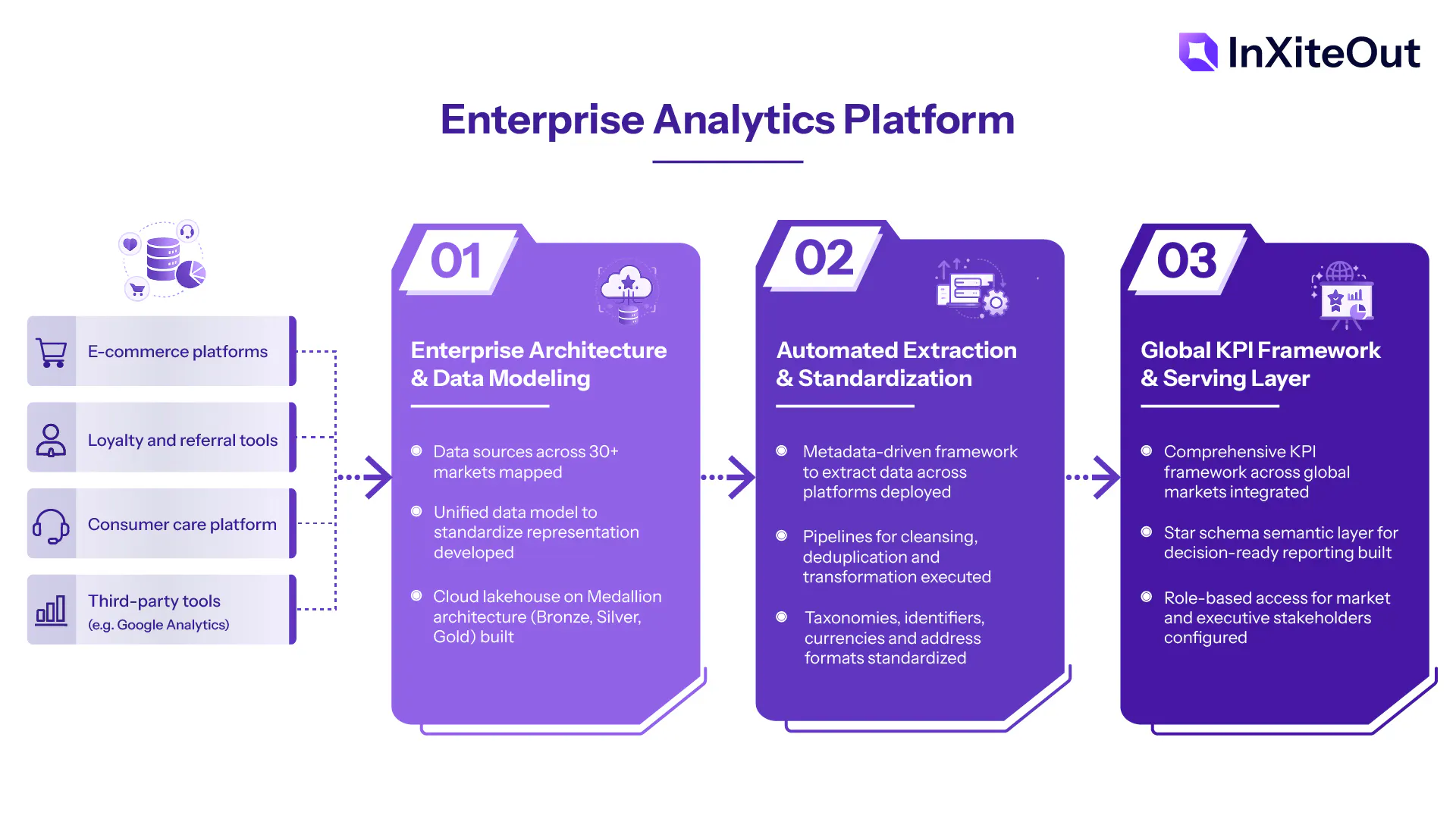
Automated Extraction and Standardization Framework
A highly configurable, metadata-driven automation framework was deployed to seamlessly extract data from e-commerce platforms, loyalty and referral tools, and the consumer care platform. As data progressed through the layers, PySpark pipelines executed robust cleansing, deduplication, and complex transformations, processing over 66 million data points daily.
This automated framework standardized product taxonomies, customer identifiers, date and time structures, currencies, and address formats, successfully converting varied, market-specific schemas into a unified, high-quality format.
Global KPI Framework and Serving Layer
To guarantee reporting consistency across the global organization while accommodating regional nuances, the solution integrated a comprehensive KPI framework. A high-performance semantic serving layer, structured around a star schema data model, was built to support decision-ready reporting.
This centrally governed layer exposed aggregated, pre-computed metrics, powering over 60 interactive dashboards with role-based access controls. This structure enabled both granular, operational analysis for individual markets and high-level global benchmarking for executive stakeholders.
Technology Stack
- Azure ETL Stack (Data Factory, Databricks (PySpark), Synapse)
- Power BI
Benefits Delivered
The platform delivered measurable improvements across operational efficiency, analytics maturity, and business adoption:
- End-to-End Automation and Efficiency: By automating the full data lifecycle, the platform reduced operational overhead and cut data preparation time by 70%. This eliminated reporting latency and enabled business intelligence teams to transition from manual extraction to self-serve analytics.
- Enterprise-Scale Adoption: The solution successfully powers over 60 interactive dashboards, driving daily engagement from approximately 1,200 active business users across regional and global teams.
- Comprehensive Visibility: Stakeholders achieved complete transparency, enabling both granular performance insights for individual markets and high-level global comparative reporting.
Suggested Reads

Accelerating Pharmacology Research with Knowledge Graphs
Discover how a Fortune 500 pharma company used AI-powered knowledge graphs to analyze research papers, generate structured hypothesis, and accelerate pharmacology insights by 60%.

Centralizing Private LLM Governance for Enterprise Scale
Discover how a leading pharmaceutical company centralized AI governance for 100+ private LLMs, reducing costs and enabling secure enterprise-scale deployment with standardized guardrails.

Accelerating Pharma R&D: Automating Behavioral Analysis with Computer Vision
Learn how AI video analytics automated behavioral tracking in pharma research, reducing manual review and accelerating drug R&D insights.