
Share this Case Study
Accelerating Pharmacology Research with Knowledge Graphs
Executive Summary:
In this case study, we explore how InXiteOut helped a Fortune 500 pharmaceutical company design and deploy a knowledge graph platform with multi-agent extraction framework to automatically surface cross-document relationships, generate evidence-backed research hypotheses, and cut insight turnaround time by 60%, delivering 2X ROI within the first year.
Client Context
A Fortune-500 pharmaceutical major continuously analyses publicly available data (such as research papers, clinical trial data, and reports from PubMed and Embase) to drive pharmacology research and competitive intelligence. This critical ongoing analysis requires tracking drug components, patient histories, therapeutic benefits, side effects, and complex drug interactions.
The Challenge
The existing analysis was an expert-driven, manual, and highly time-consuming process subject to human bias. The lack of a unified, cross-document view meant that critical insights and breakthrough opportunities remained buried in isolated data silos. This created several major bottlenecks for the research team:
- Researchers struggled to identify connections across different therapeutic areas, frequently overlooking competing or reinforcing hypotheses.
- Validating evidence across multiple papers required manual work that scaled exponentially as the volume of research documents grew.
- The slow, non-standardized process hindered the client's ability to quickly identify novel opportunities and capture market share ahead of competitors.
The client needed an advanced AI platform to expedite the research process, uncover hidden cross-document relationships, and drastically accelerate their speed to market.
The InXiteOut Approach
We developed a solution that automatically converts incrementally ingested research papers into an interactive knowledge graph. This platform allows researchers to visualize relationships between different entities, navigate topics of interest, and extract rich, research-grade insights (for example: "X component of Y drug interacts with Z component of other drugs negatively to produce P side-effect in patients with Q history and R demography").
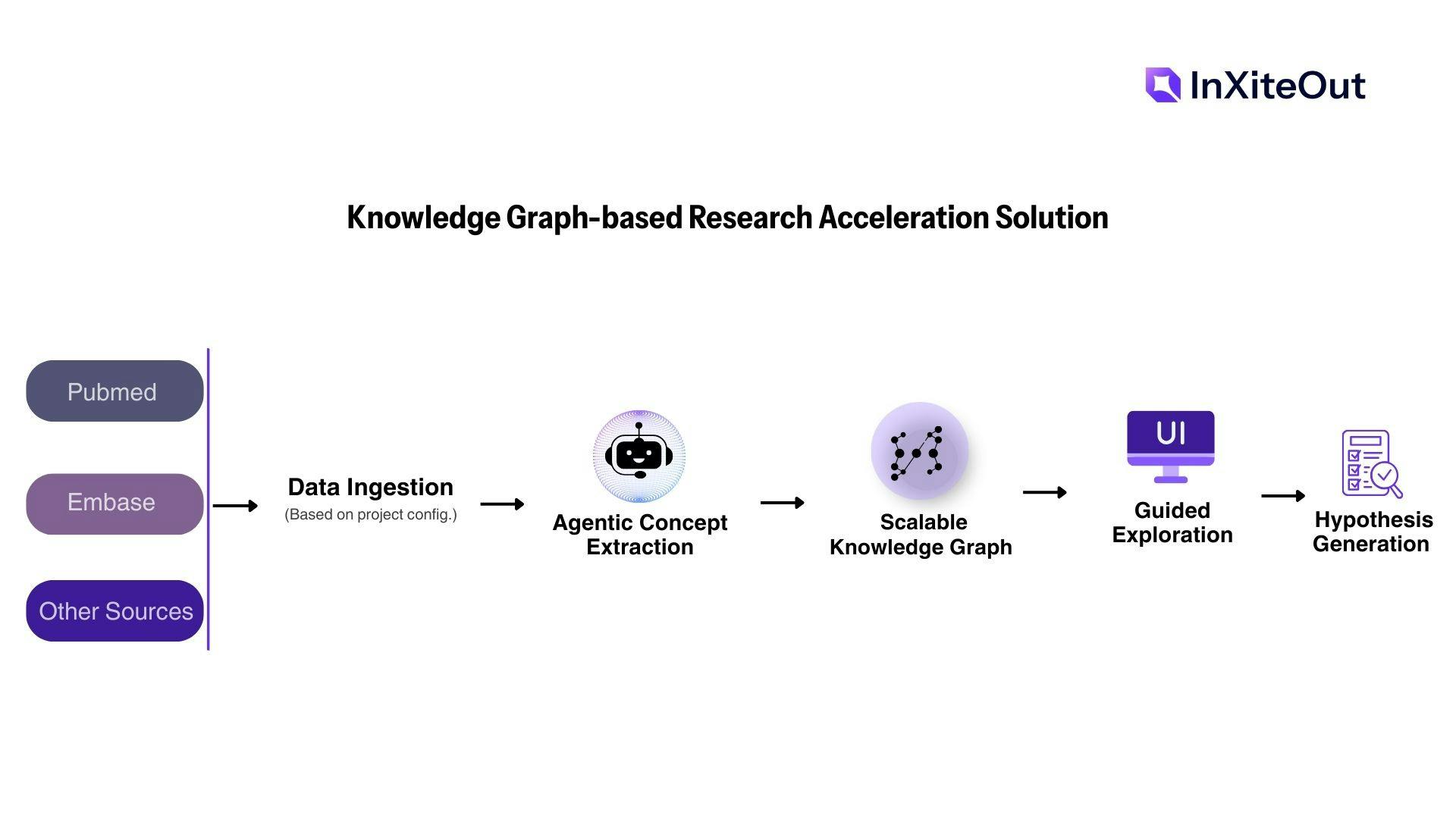
Data Ingestion and Agentic Concept Extraction
The platform uses a periodic ingestion pipeline to pull relevant data from the PubMed and Embase APIs, based on specific project configurations. We deployed a multi-agent AI framework to automatically extract diverse metadata, including domains, themes, timelines, and entities. These agents generate complex concepts and meta-concepts, actively identifying deep contextual relationships (such as causation, co-occurrence, and correlation) between different entities across thousands of documents.
Scalable Knowledge Graph
To make this vast web of connections searchable and scalable, we engineered a robust knowledge graph layer utilizing advanced GraphRAG (Graph Retrieval-Augmented Generation) capabilities. By combining Neo4j as the graph database with Azure AI Search as the vector database, the system allows the LLM to understand both the directionality and the precise scale of cross-interactions between different drugs, patient histories, and demographic factors.
Guided Exploration and Hypothesis Generation
We designed a comprehensive user journey that transforms passive data into active innovation multipliers. Researchers can visually navigate the knowledge graph, filtering by domains or timelines to see the strength of relationships. Users can interact with the graph using natural language directly against the dataset to extract strategic insights. By selecting paired concepts, researchers can trigger the tool to propose novel, evidence-backed hypotheses, which can then be exported as actionable reports to accelerate R&D cycles.
Technology Stack
- Frameworks: MS AutoGen v0.2 (multi-agentic framework), Neo4j-Cypher (graph RAG), LangChain (LLM orchestration)
- Storage: Neo4j (graph database), Azure AI Search (vector database)
Benefits Delivered
The knowledge graph platform delivered measurable scientific and financial returns for the client's pharmacology research:
- ~60% Faster Insight Extraction: Reduced the turnaround time (TAT) for analyzing external research, allowing the team to process higher volumes of data.
- 2X ROI in Year One: The operational efficiency gains and reduction in full-time equivalent (FTE) manual effort exceeded the solution's total cost of ownership (TCO) by double in the first twelve months of deployment.
- Structured Hypothesis Generation: Enabled the development of traceable, evidence-backed innovation hypotheses, resulting in improved scientific defensibility and shorter validation cycles.
- Visible Cross-Therapeutic Insights: Uncovered drug and component relationships, cross-therapeutic interactions, and demography-specific effects that were unobserved under the manual process.
Suggested Reads
Accelerating Pharmacology Research with Knowledge Graphs
Discover how a Fortune 500 pharma company used AI-powered knowledge graphs to analyze research papers, generate structured hypothesis, and accelerate pharmacology insights by 60%.

Transforming Enterprise Knowledge: How an AI Assistant Delivered Instant Employee Support
Learn how a generative AI-powered Enterprise Knowledge Assistant transformed internal knowledge management, reduced HR & IT tickets by 15%, and delivered sub-second employee support.

Accelerating Sales Outcomes with GenAI: Mining Conversations for Actionable Intelligence
Explore how InXiteOut helped a client scale sales operations with a GenAI platform that processed 20,000 minutes of customer data weekly into sales insights.