
Share this Case Study
Centralizing Private LLM Governance for Enterprise Scale
Executive Summary:
For a leading pharmaceutical manufacturer running over a hundred private LLMs across thousands of internal users, decentralization was creating significant operational friction. This case study details how InXiteOut architected a centralized LLM governance platform to cut LLM management costs by 30%, improve AI adoption, and bring consistent governance across every department.
Client Context
A leading pharmaceutical manufacturer relies on private Large Language Models (LLMs) rather than commercial APIs to ensure data privacy and maintain optimal performance on specialized pharma datasets. Historically, the organization fine-tuned and deployed these private models across various operations in a decentralized manner.
The Challenge
With over a hundred private LLMs supporting thousands of internal users, the decentralized approach created significant operational friction:
- Cost Inefficiencies: Redundant infrastructure and duplicated fine-tuning efforts inflated total management costs.
- Governance Risks: The lack of a unified security and compliance standard made it difficult to enforce data privacy and content safety.
- Deployment Bottlenecks: Departments lacked a streamlined pipeline to test, benchmark, and deploy models efficiently.
The client needed a centralized framework to standardize the fine-tuning, deployment, and governance of all internal LLMs across different departments.
The InXiteOut Approach
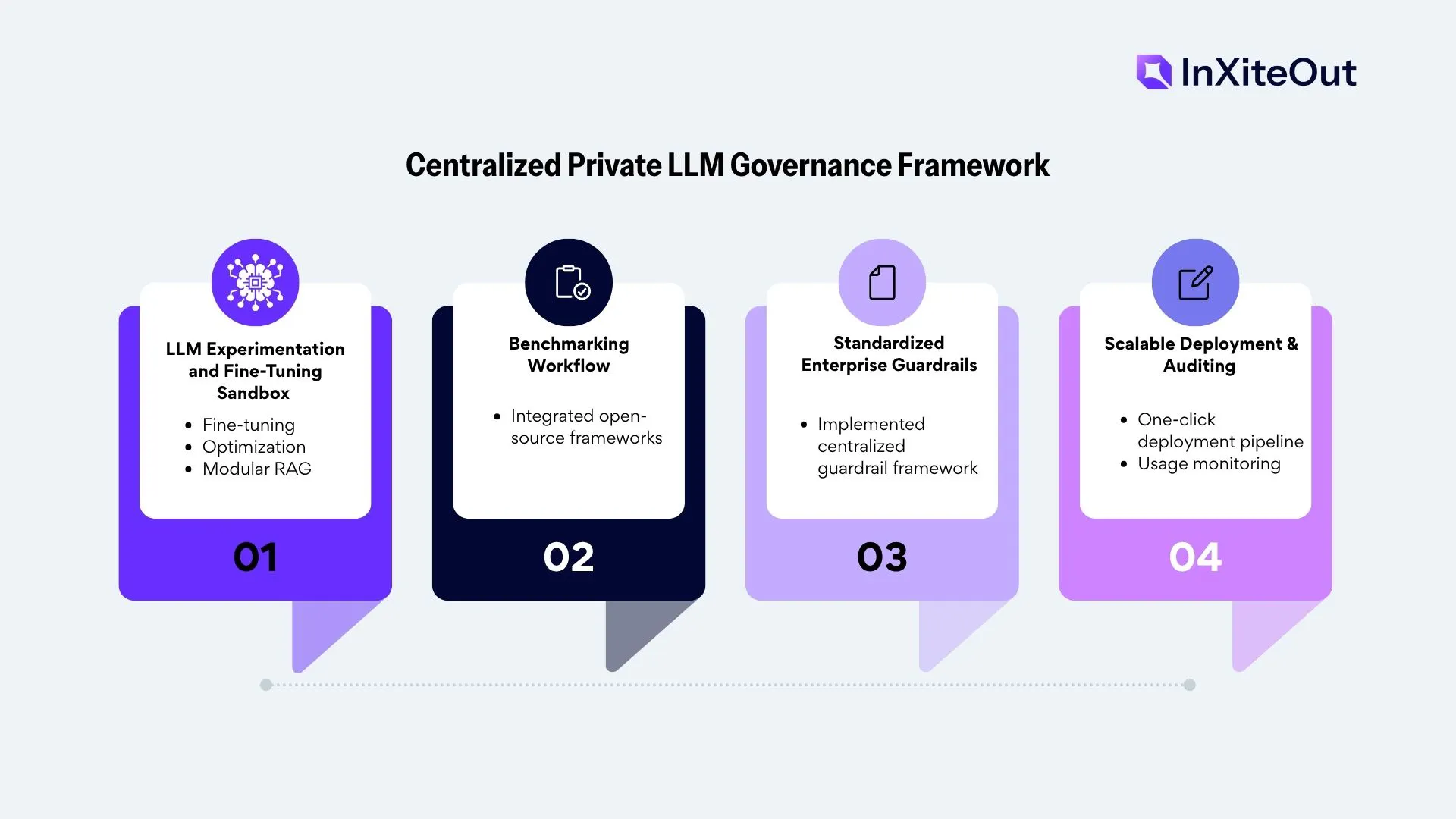
We collaborated with the client's IT team as the AI partner to architect and build a centralized LLM governance and deployment platform. The solution involved the following components:
LLM Experimentation and Fine-Tuning Sandbox
We built a low-code sandbox utilizing PyTorch DDP and HuggingFace PEFT. This allowed users to easily select the experimentation modality and foundational open-source model, and to provide their datasets to fine-tune models for their specific use cases. The sandbox included the most common fine-tuning approaches (LoRA, QLoRA, and SFT), model footprint optimization techniques (quantization, pruning, and distillation), and a reusable modular RAG implementation.
Benchmarking Workflow
To ensure quality and reliability, we integrated open-source frameworks such as DeepEval and Ragas. This enabled users to independently benchmark their LLMs and RAG systems against predefined industry-standard datasets or their own custom metrics.
Standardized Enterprise Guardrails
To ensure compliance and safety across all departments, we integrated the NVIDIA NeMo Guardrails framework. This centralized layer allows administrators to easily define, orchestrate, and enforce strict parameters for topic control, PII detection, RAG grounding, jailbreak prevention, and content safety at consistently low latency.
Scalable Deployment and Auditing
We implemented a one-click deployment pipeline utilizing the NVIDIA Triton Inference Server deployed on Kubernetes, ensuring enterprise-scale adoption and high throughput. All model predictions, along with resource and infrastructure usage, are routed to a centralized monitoring dashboard. This provides IT administrators with transparent cost-tracking capabilities, automated auditing, and usage-based billing for different internal departments.
Technology Stack
- Models and Frameworks: PyTorch DDP, HuggingFace PEFT, DeepEval, and Ragas
- Architecture and Governance: NVIDIA NeMo Guardrails, NVIDIA Triton Inference Server, and Kubernetes.
Benefits Delivered
The centralized platform optimized the client's AI infrastructure, delivering measurable operational and financial improvements:
- ~30% Cost Reduction: Lowered total LLM management costs by minimizing effort redundancy, optimizing infrastructure, improving energy efficiency, and reducing management overhead.
- ~10% Increase in AI Adoption: Increased internal LLM usage across the organization by fostering trust through standardized guardrails and the centralized sharing of best practices.
- Standardized Governance: Ensured all department-level LLMs strictly adhered to enterprise requirements for data privacy, PII detection, and content safety.
- Streamlined Operations: Replaced fragmented, decentralized processes with a unified, self-serve pipeline for fine-tuning, benchmarking, and deployment.
Suggested Reads

Accelerating Pharmacology Research with Knowledge Graphs
Discover how a Fortune 500 pharma company used AI-powered knowledge graphs to analyze research papers, generate structured hypothesis, and accelerate pharmacology insights by 60%.

Transforming Enterprise Knowledge: How an AI Assistant Delivered Instant Employee Support
Learn how a generative AI-powered Enterprise Knowledge Assistant transformed internal knowledge management, reduced HR & IT tickets by 15%, and delivered sub-second employee support.

Accelerating Sales Outcomes with GenAI: Mining Conversations for Actionable Intelligence
Explore how InXiteOut helped a client scale sales operations with a GenAI platform that processed 20,000 minutes of customer data weekly into sales insights.