
Share this Case Study
Cross-Channel ML Demand Forecasting for Amazon Vendors
Executive Summary:
Our client, a B2B software platform helping brands manage Amazon inventory, required higher forecast accuracy than Amazon's native Vendor Central could provide. InXiteOut developed a cross-channel machine learning solution that enriched historical sales data with web behavior, pricing, reviews, and promotional signals. By moving beyond isolated sales history, the custom model delivered a ~15% improvement in sell-through accuracy and produced decision-ready 26-week sell-in recommendations, enabling major vendors to optimize their inventory planning and purchase order execution.
Client Context
Our client, a B2B software platform that helps Amazon brands optimize their e-commerce performance, was consistently experiencing low accuracy with Amazon's native Vendor Central forecasts for inventory planning and sell-through predictions. Although the client actively curated a rich dataset of cross-channel metrics, including campaign responses, web behavior, online reviews, and pricing dynamics, this data remained siloed and was not being utilized to improve demand predictions.
They needed a machine learning solution to integrate these diverse signals with historical sales data, generating highly accurate sell-through forecasts and decision-ready sell-in recommendations for their vendors.
The InXiteOut Approach
We engineered an end-to-end forecasting pipeline that integrated siloed data streams into a unified predictive model. The solution was developed in three core phases:
Strategic Prioritization and Domain Mapping
We collaborated with the client to define baseline metrics and identify the specific parameters most likely to impact demand. From there, we established a comprehensive data enrichment strategy, mapping these attributes across the client’s existing, siloed data tables. To maximize business impact, we applied an ABC prioritization model to isolate high-value vendors and ASINs based on core revenue and volume KPIs.
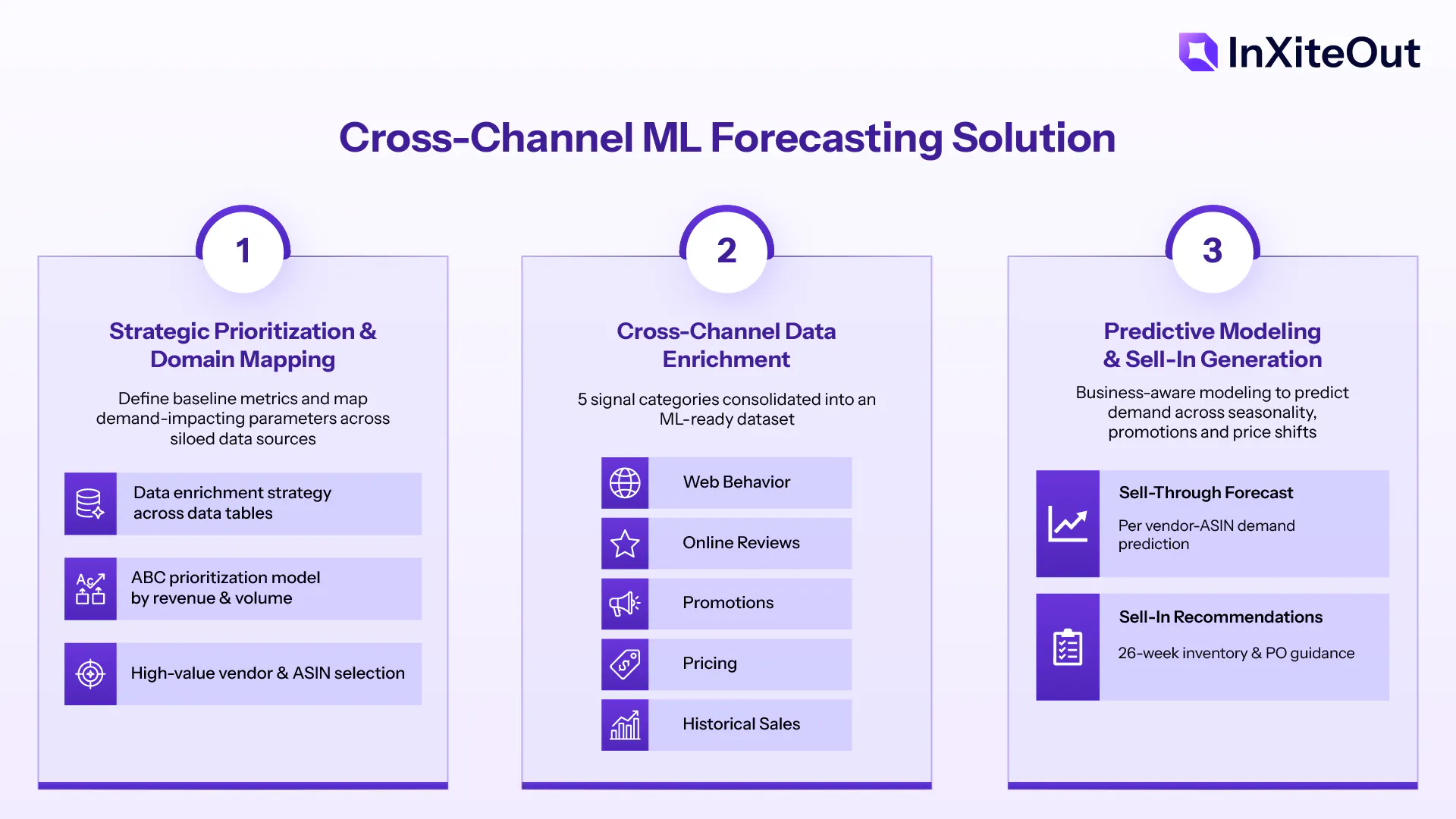
Cross-Channel Data Enrichment
We constructed an enriched dataset to feed the machine learning pipeline by consolidating signals across five distinct categories:
- Web Behavior: Glance views, conversion rates, and lost buy box %.
- Online Reviews: Relative negative review metrics.
- Promotions: AMS spend, Prime Day indicators, and other special event flags.
- Pricing: Average buy box price, price discounts, and best deal indicators.
- Historical Sales: Past sell-through volumes and out-of-stock records.
Predictive Modeling and Sell-In Generation
We applied business-aware feature engineering to the enriched dataset to capture complex market dynamics like seasonality, promotional spikes, and price elasticity. A custom machine learning model was then trained and validated to forecast granular sell-through demand for each target vendor-ASIN combination.
Rather than stopping at raw demand predictions, the system combined these forecasts with current inventory levels and historical out-of-stock data. This integration allowed the tool to generate decision-ready sell-in recommendations over a 26-week lookahead horizon, equipping vendors with actionable insights for long-term supply chain planning and purchase order execution.
Technology Stack
- AWS ETL & Machine Learning Stack (Glue, S3, SageMaker, Redshift)
Benefits Delivered
The ML-driven forecasting solution was successfully integrated by the client, replacing Amazon’s native forecasts as the primary basis for inventory planning for their major vendors:
- ~15% Higher Forecast Accuracy: The custom sell-through predictions consistently outperformed Amazon Vendor Central baselines across all targeted vendor-ASIN combinations.
- High Vendor Adoption: The decision-ready 26-week sell-in recommendations were quickly adopted by the platform's top customers.
- Optimized Inventory Planning: Vendors achieved significantly better purchase order fulfillment outcomes by relying on enriched, cross-channel data rather than isolated sales history
Suggested Reads

Accelerating Pharmacology Research with Knowledge Graphs
Discover how a Fortune 500 pharma company used AI-powered knowledge graphs to analyze research papers, generate structured hypothesis, and accelerate pharmacology insights by 60%.

Centralizing Private LLM Governance for Enterprise Scale
Discover how a leading pharmaceutical company centralized AI governance for 100+ private LLMs, reducing costs and enabling secure enterprise-scale deployment with standardized guardrails.

Accelerating Pharma R&D: Automating Behavioral Analysis with Computer Vision
Learn how AI video analytics automated behavioral tracking in pharma research, reducing manual review and accelerating drug R&D insights.