
Share this Case Study
Automating Enterprise Data Operations: How an AI-Powered Portal Made New-Source Onboarding 90%+ Faster
Client Context
The client is a premier real estate institutional sales & marketing solutions provider that drives scalable, high-velocity sales for developer projects. Operating at scale, the client sources over 1Mn prospective buyer records annually across 100+ real estate project mandates. A significant share of this lead data arrives from third-party sources, including external data vendors and channel partners, in multiple, non-standardized formats, making the rapid, accurate ingestion of this data a direct driver of revenue velocity.
However, ingestion of this third-party data relied on manual, fragmented workflows that could not keep pace with the client's volume, creating operational risk and delaying revenue. Key challenges included:
- Inconsistent, non-standard inputs: Data arrived from many vendors in multiple formats with no common standard, so every file had to be mapped and cleaned by hand against backend schemas before it could be used.
- Slow, manual onboarding: Bringing a new third-party source online took 1-2 days of manual mapping and validation, delaying the point at which fresh leads could be worked and revenue realized.
- Effort that did not scale: Because the process was people-dependent, every new vendor added linear manual load, turning the data team into a bottleneck as volumes grew.
- Weak governance: The absence of transparent tracking and role-based access control left limited oversight of sensitive third-party data.
Consequently, the client needed a scalable, AI-powered Data Ingestion Platform to automate field mapping and validation, standardize incoming data, and enforce enterprise-grade governance.
The InXiteOut Approach
This platform was architected and deployed across three stages:
1. Diagnostic and Business Analysis
Before automation was applied, a comprehensive analysis of the client’s incoming third-party vendor data and ingestion workflows was conducted.
- Source Profiling: Historical vendor files were profiled to establish baseline schemas. This involved analyzing data from multiple third-party vendors and channel partners to understand the variety of incoming formats.
- Metadata Definition: Business requirements were mapped to define a "Mandatory Metadata" standard. This ensured that critical attributes, such as vendor posting date, data category, and data source, were captured consistently for every upload.
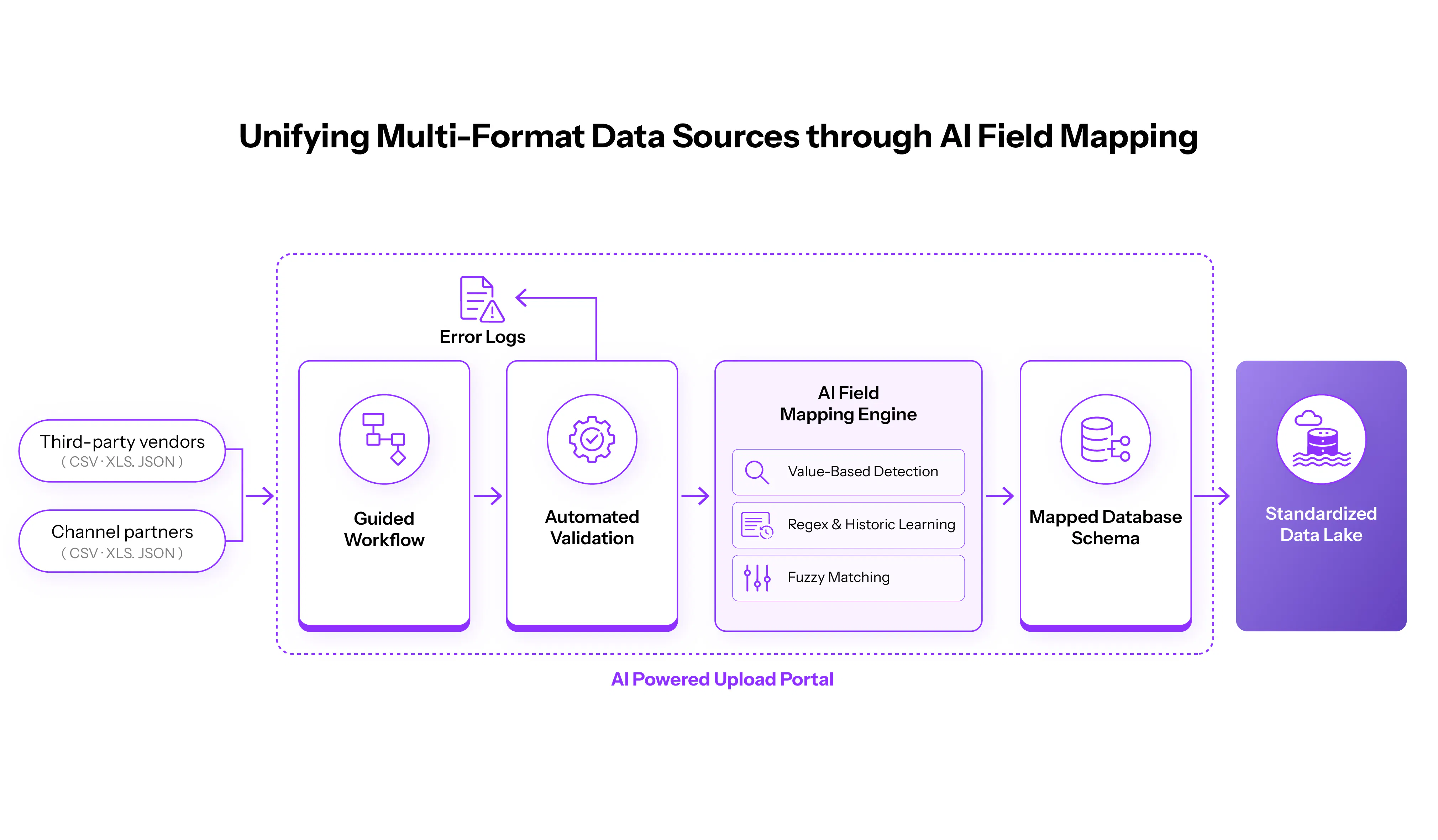
2. Data Upload Portal
A secure, MERN-based Data Upload Portal was developed as the single, self-service interface the client's teams use to ingest third-party data from all sources.
- Guided Workflow: A three-step upload wizard guides the client's users through file selection, metadata entry, and validation.
- Automated Validation: Files are subjected to pre-processing checks immediately upon upload. Clear error logs are generated if format inconsistencies are detected, reducing the need for manual intervention.
- Role-Based Governance: A strict permission layer was built to manage admin approvals and user access, ensuring that only authorized personnel can map fields or approve new schemas.
3. AI Field Mapping Engine
To eliminate manual reconciliation, a self-learning AI Field Mapping Service was engineered to automatically identify and map incoming columns to the database schema. The engine combines LLM-based reasoning with deterministic checks in a multi-layered approach to handle variations in vendor data:
- Regex & Historic Learning: Patterns such as email addresses are identified using regex checks combined with historical learning from previous uploads.
- Fuzzy Matching: Column naming variations (e.g., "name2" vs. "Surname") are resolved using fuzzy matching algorithms to ensure consistent mapping.
- Value-Based Detection: Ambiguous fields are mapped by an LLM that interprets the data content itself rather than relying solely on column headers, recognizing patterns such as 6-digit integers as PIN codes or structured strings as IFSC codes.
Technology Stack
- MERN Stack (React.js, Node.js, MongoDB)
- Azure Databricks, Apache Spark (PySpark)
- Azure Data Lake Storage Gen2
- Unity Catalog
- LLMs
Benefits Delivered
The platform delivered measurable business impact by accelerating data readiness, improving governance, and enabling faster downstream decision-making.
- 90%+ Faster Onboarding of New Sources: Bringing a new third-party source online dropped from 1-2 days to under an hour, letting fresh leads be worked and revenue realized far sooner.
- 100% Elimination of Manual Checks: All manual template verification was replaced by automated validation logic, ensuring that only clean, compliant data enters the pipeline.
- Zero Dependency on Engineering Teams: New fields, vendors, and formats can be added dynamically with admin approval, so the modular platform absorbs new data sources and keeps pace as volumes grow, without engineering intervention or pipeline redesign.
- Enhanced Data Security: Sensitive third-party data is protected through Unity Catalog for governance, access control, and lineage, reinforced by Microsoft SSO and strict session controls.
Suggested Reads

Decoding the Commercial Vehicle Rejector: How Competitive Intelligence Reshaped an OEM's Strategy
Find out how AI-powered VoC analytics helped a global automotive OEM de-risk a major fuel tank design change, safeguarding sales and improving product decisions.

How VoXLoop Insights Helped Optimize the Early Ownership Experience of a New Lifestyle SUV
Learn how VoXLoop Insights empowered a top automaker to enhance SUV ownership quality, resolve early issues, and deliver a superior lifestyle experience.

Unstructured Voice to Strategic Insight: How InXiteOut Powers an Automotive Leader's Customer-First Strategy
Discover how InXiteOut transformed unstructured voice data into strategic insights, enabling a Fortune 500 automotive leader to accelerate customer-first decisions.