Share this Case Study
How AI-Driven Insights De-Risked a Critical Design Change for a Global Auto OEM
Client Context
A leading global automotive manufacturer planned to reduce the fuel tank capacity of one of its popular utility vehicles to improve manufacturing efficiency.
To evaluate the impact of this change, the client commissioned telephonic interviews with existing owners and prospective buyers. The objective was to understand their ownership profiles, vehicle usage patterns, and refueling behaviors, and to assess the likelihood of inconvenience resulting from the reduced tank size.
The client sought to move beyond internal assumptions and validate whether this design change would negatively impact customer satisfaction or future sales, particularly in high-usage segments, before finalizing the decision.
The InXiteOut Approach
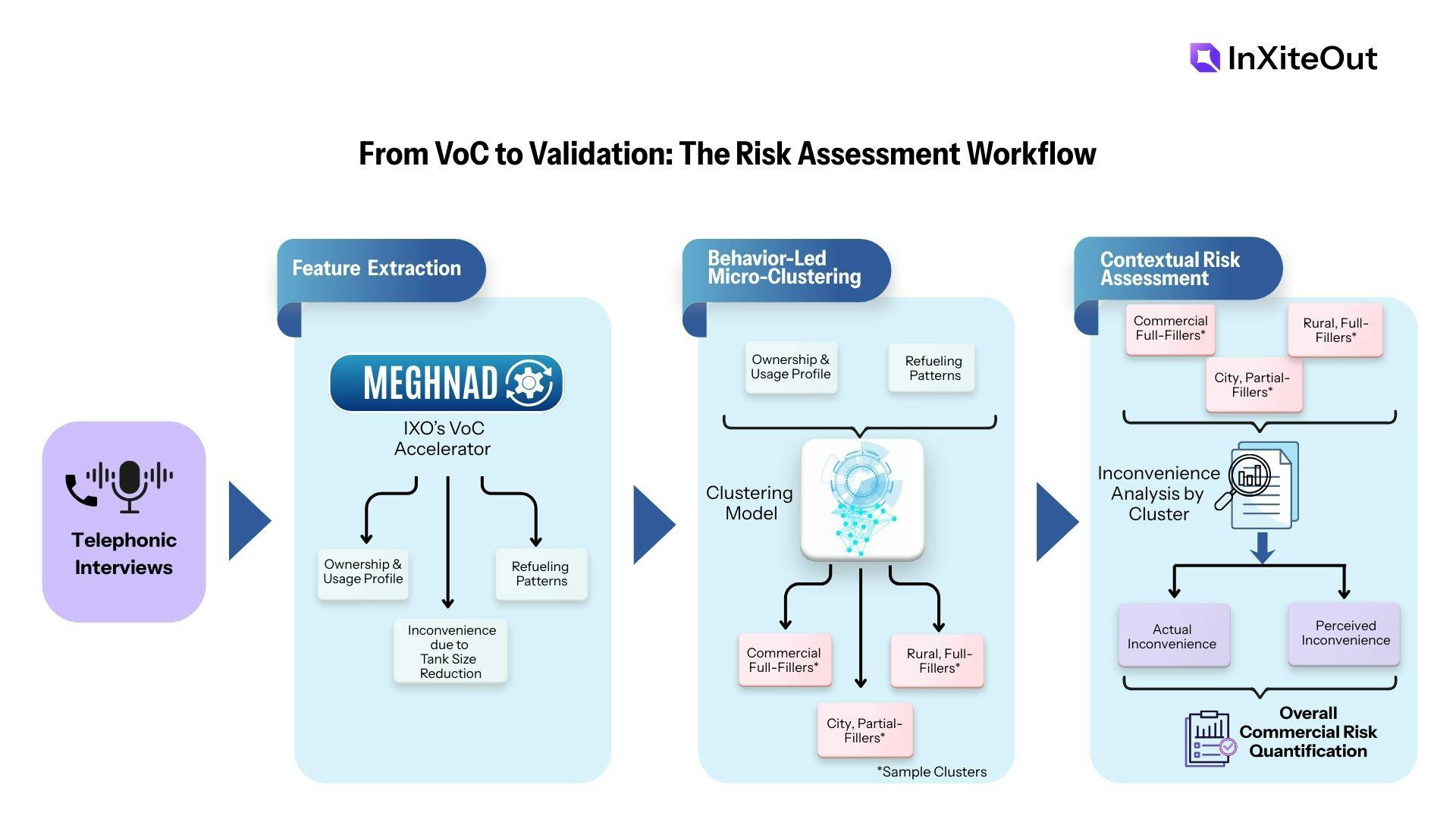
The client provided raw audio recordings from their telephonic interviews. InXiteOut leveraged VoXLoop, proprietary VoC intelligence platform, to process this unstructured data and derive actionable insights through a three-stage process:
VoXLoop-driven feature extraction
We ingested the raw survey recordings into VoXLoop to transform the unstructured voice data into a structured analytical dataset. The platform processed the survey recordings to extract specific ownership and behavioural profiles for every respondent, including:
- Ownership & Usage Profile: Number of vehicles owned, usage type (commercial vs. personal), and primary usage location (highway, rural areas, or city).
- Refueling Patterns: Extraction of refueling frequency, typical distance to fuel stations, and filling habits (full tank vs. partial fills).
- Perceived Inconvenience: Capturing the customer's specific response regarding whether a reduced tank size would disrupt their daily operations.
Behavior-led micro-clustering
Using the structured data, we moved beyond simple demographics to create behavior-based micro-clusters. We mapped the specific habits of each user group to understand their operational reality:
- Refueling Behavior: Segregating users into "Full Fillers" (who maximize range) versus "Partial Fillers" (who refuel frequently in small amounts).
- Usage Patterns: Differentiating users based on their usage type (commercial vs. personal) and primary usage location, distinguishing between high-mileage highway drivers, city commuters, and village-based users.
Contextual risk assessment
Finally, we mapped the potential impact of the design change against these specific behavioral clusters. By correlating the customer's stated feedback with their operational realities (such as daily distance driven and fuel station proximity), the analysis distinguished between:
- True Operational Inconvenience: Users for whom the change created genuine business risk (e.g., commercial users on long routes with sparse pumps).
- Perceived Inconvenience: Users who expressed concern, but whose actual driving habits and access to fuel stations indicated the change would be manageable.
Technology stack used
- VoXLoop, IXO’s Agentic VoC Intelligence Platform
- Azure ETL Platform
Benefits Delivered
The solution transformed raw survey recordings into a clear strategic direction, enabling a data-backed product decision:
- Identified Critical Commercial Risk: The analysis estimated a potential 10-15% sales risk owing to the high-mileage commercial segment, revealing that increased refueling frequency on sparse highway routes constituted a genuine operational barrier.
- Isolated "True" vs. "Perceived" Inconvenience: The study validated that for other segments (such as city drivers or partial fillers), the impact was low-risk and manageable. This allowed the client to distinguish between vocal concerns and actual business risk.
- Guided Strategic Product Decision: Based on this evidence, the client decided to retain the higher-capacity fuel tank, directly safeguarding future sales volume and customer satisfaction in their most critical market segments.
Suggested Reads
Decoding the Commercial Vehicle Rejector: How Competitive Intelligence Reshaped an OEM's Strategy
Find out how AI-powered VoC analytics helped a global automotive OEM de-risk a major fuel tank design change, safeguarding sales and improving product decisions.

How VoXLoop Insights Helped Optimize the Early Ownership Experience of a New Lifestyle SUV
Learn how VoXLoop Insights empowered a top automaker to enhance SUV ownership quality, resolve early issues, and deliver a superior lifestyle experience.

Unstructured Voice to Strategic Insight: How InXiteOut Powers an Automotive Leader's Customer-First Strategy
Discover how InXiteOut transformed unstructured voice data into strategic insights, enabling a Fortune 500 automotive leader to accelerate customer-first decisions.