
Share this Case Study
Unifying Fragmented Data Sources into a 360° View for Real Estate Sales
Client Context
InXiteOut partnered with a premier real estate institutional sales and marketing solutions provider that drives scalable, high-velocity sales for developer projects. Operating at scale, the client sources over 1Mn prospective buyer records annually across 100+ real estate project mandates to identify and convert high-intent buyers.
To enable this, the client leverages prospect data from multiple sources: enterprise CRM, campaign tools, call-center records, channel partners, and more. They also source data from third-party data vendors, which arrive in multiple formats. This leads to a fragmented data universe, with non-standardized data and no unified view of the customer.
The Challenges
- No Unified View for Sales Targeting: Customer records were scattered across multiple independent systems in multiple formats (JSON, CSV, XLS, etc.), leaving sales teams without a single, reliable view of each prospect and unable to prioritize and target high-intent buyers effectively.
- No Single Source of Truth: With the same prospect appearing across CRM, campaign tools, and third-party vendor feeds, teams could not tell which record was current, leading to conflicting outreach and an inconsistent prospect experience.
- Wasted Sales Effort on Bad Leads: Without standardized data management, duplicate, incomplete, and inconsistent records meant reps chased dead-end and repeated leads, eroding productivity and conversion rates.
- Delayed Revenue from Slow Onboarding: Bringing a new third-party lead source online took 1–2 days, with every new dataset requiring 2–4 hours of manual field mapping, validation, and preprocessing, delaying the point at which fresh leads could be worked and revenue realized.
- Manual Effort Did Not Scale: Data onboarding and standardization were people-dependent, so every new vendor added linear manual load. As lead volume grew toward 1Mn+ records a year, the data team became a bottleneck.
- Weak Data Governance and Compliance Risk: The absence of standardized management and clear ownership across multiple systems meant no data lineage or quality controls, and limited oversight of sensitive third-party buyer data.
To overcome this, the client needed a governed platform that could automate data ingestion, standardize records, and deliver a single, trusted 360° view of every prospect, giving sales teams faster, more reliable access to lead data.
The InXiteOut Approach
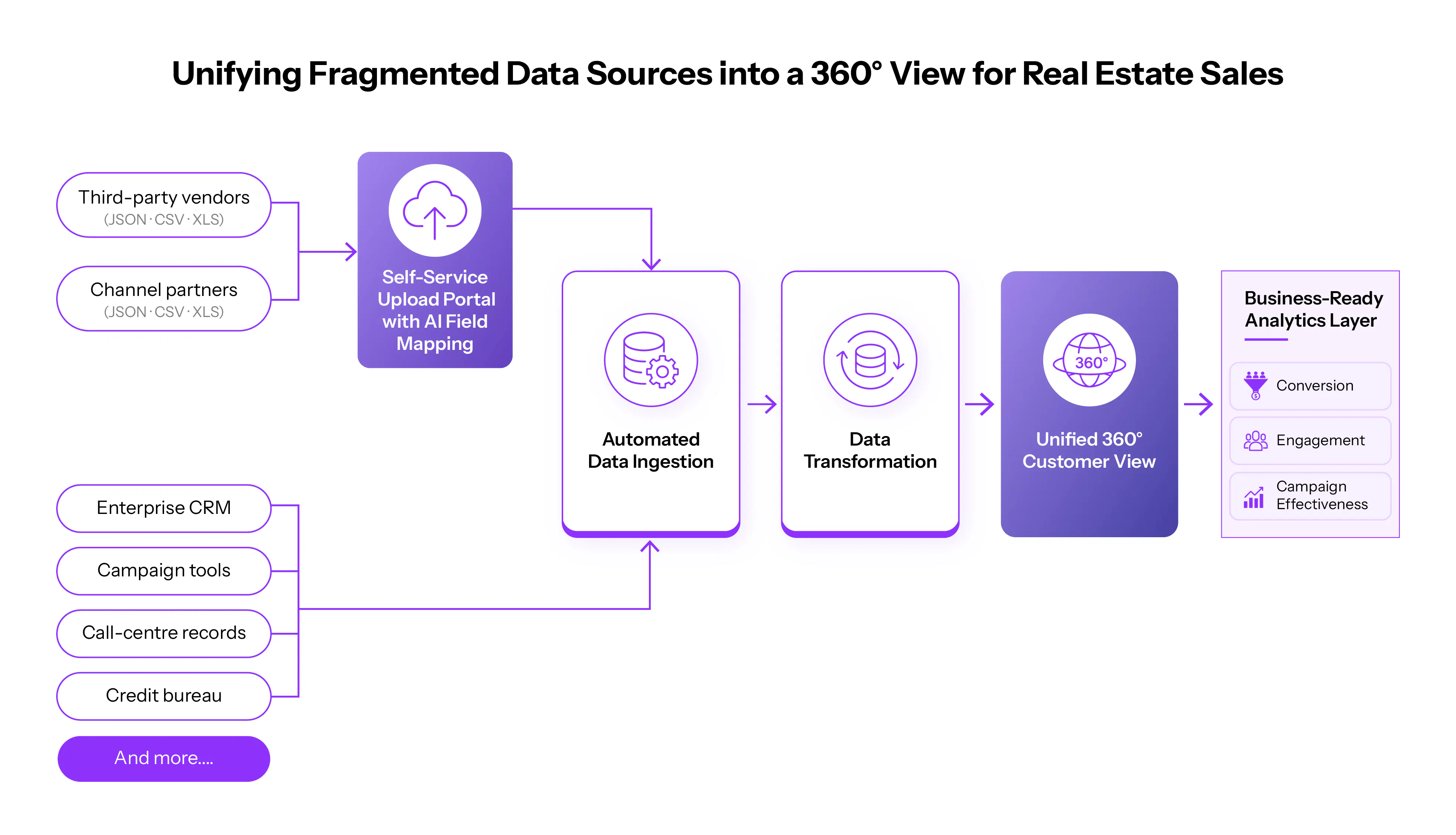
InXiteOut built a scalable Unified Customer View platform on Azure, delivered across five stages, from assessing the data ecosystem to enabling business-ready analytics:
Data Ecosystem Assessment
We began by mapping the client's entire data ecosystem, analyzing 100+ data sources spanning over 160Mn prospect records accumulated to date. We assessed each source's structure, data quality, and how prospect data flowed between systems. This produced a complete source inventory, a baseline of the quality, duplication, and governance gaps undermining sales, and a target standardized schema, the foundation for every downstream stage from ingestion through to the unified customer view.
Self-Service Upload Portal with AI Field Mapping
We built a self-service upload portal that let business teams upload third-party data directly, without pre-processing. Because this data arrived in multiple, non-standardized formats, we built AI-based field mapping into the portal that automatically maps each source's fields to the standardized schema by analyzing column names, metadata, and data semantics. This eliminated manual mapping and significantly accelerated the onboarding of new datasets.
For the complete framework, implementation, and business impact, read our detailed case study: Automating Enterprise Data Operations: How an AI-Powered Portal Made New-Source Onboarding 90%+ Faster
Automated Data Ingestion
Azure Data Factory orchestrated automated, direct ingestion from 10+ vendor systems on an ongoing basis, including Microsoft Dynamics 365, LeadSquared, and Credit Bureau, alongside client-uploaded files, all consolidated into a single layer and removing the manual exports and imports that had slowed onboarding. Ingestion ran through a framework-driven pipeline combining scheduled batch and event-driven triggers, with incremental loads that pulled only new or changed records to keep prospect data fresh without reprocessing entire datasets.
Azure Databricks and Apache Spark handled the initial processing flow, creating a consistent, reusable landing zone for downstream transformation. Because the framework was configuration-driven, new sources could be onboarded by defining their parameters rather than building custom pipelines, letting ingestion scale reliably as vendors and data volumes grew.
Data Transformation & Unified 360° Customer View
Using ETL pipelines in Azure Databricks, we transformed ingested raw, disparate records into clean, standardized, and deduplicated data modeled against a normalized customer data model. This transformation layer validated and reconciled records from every source, resolving inconsistencies, removing duplicates, and reshaping each dataset to conform to a single canonical structure.
The resulting model consolidated all processed data into a centralized repository, organized into domain-specific tables like Contact, Address, Employment, Financial, Social, Car Ownership, Engagement, Project, and Source — so a single query could retrieve a complete 360° customer profile across all sources.
Governance was built in through Unity Catalog, providing centralized access control, data lineage, and auditability across the platform.
Business-Ready Analytics Layer
On top of the unified model, we built a curated set of summary, domain-specific tables that presented business-ready metrics and KPIs. This layer enabled analytics and self-service reporting, letting business teams explore and “talk to” their data directly, without depending on engineering for every query. With these tables, teams could track the performance of their sales outreach — monitoring conversion, engagement, and campaign effectiveness across projects — and use those insights to prioritize high-intent buyers and continuously refine their sales strategy.
Technology Stack Used
- Azure Data Factory (ADF)
- Azure Data Lake Storage Gen2
- Azure Databricks, Apache Spark (PySpark)
- Unity Catalog
- LLMs
- MERN Stack (React.js, Node.js, MongoDB)
Benefits Delivered
- Faster, Smarter Sales Outreach: Sales teams gained a single, trusted 360° view of every prospect, enabling them to prioritize high-intent buyers, target outreach precisely, and support faster conversion.
- 30x Faster Customer Lookup: Reduced customer search time from 15–30 minutes to under 30 seconds, giving reps instant access to complete prospect profiles.
- 90%+ Faster Third-Party Data Onboarding: Cut new third-party data-source onboarding from 1–2 days to under an hour, driven by AI-based field mapping that removed most manual mapping effort.
- Governed, Compliant Data: Centralized access control, data lineage, and auditability through Unity Catalog established clear ownership and oversight of sensitive prospect data.
- Scalable Foundation for Analytics and AI: A standardized, governed data foundation now supports self-service analytics, reliable reporting, and future AI initiatives.
Suggested Reads

Decoding the Commercial Vehicle Rejector: How Competitive Intelligence Reshaped an OEM's Strategy
Find out how AI-powered VoC analytics helped a global automotive OEM de-risk a major fuel tank design change, safeguarding sales and improving product decisions.

How VoXLoop Insights Helped Optimize the Early Ownership Experience of a New Lifestyle SUV
Learn how VoXLoop Insights empowered a top automaker to enhance SUV ownership quality, resolve early issues, and deliver a superior lifestyle experience.

Unstructured Voice to Strategic Insight: How InXiteOut Powers an Automotive Leader's Customer-First Strategy
Discover how InXiteOut transformed unstructured voice data into strategic insights, enabling a Fortune 500 automotive leader to accelerate customer-first decisions.