
Share this Case Study
Accelerating Real Estate Sales Outreach with Intelligent Segmentation and Propensity Prioritization
Client Context
The client is a leading real estate institutional sales and marketing service provider, undertaking sales for 100+ real estate projects annually. To identify leads for these projects, the client continually sourced prospect data and had built a corpus of 160 Mn+ prospect profiles from multiple channels, with data from these fragmented sources already organized into a unified Customer 360 view. [Read more about this case study here]
For every developer project campaign, the client needed to identify the highest-propensity prospects from this corpus, prioritize them for targeted outreach, and convert them into site visits at the property being sold. Intelligent customer segmentation sits at the core of this process, grouping prospects effectively before propensity scoring identifies and prioritizes high-intent buyers for outreach.
However, the existing process was manual and inefficient. To find the right prospects for a project, records had to be filtered by hand against target customer characteristics, with no reliable way to prioritize whom to pursue first. Every segment had to be created separately by the engineering team, limiting business users’ flexibility to adapt and refine segments as needed.
Once prospects were identified, campaigns still had to be sent manually and lead data shared with call centers by email, with no mechanism to track how outreach performed. The absence of an integrated propensity scoring process further delayed sales outreach and reduced overall effectiveness.
The Challenge:
- Campaigns Stalled Waiting on Engineering: Segmenting a corpus of 160 Mn+ prospect profiles demanded complex queries that only the engineering team could build. Query creation stretched over several days of back-and-forth, so sales couldn't launch campaigns on their own timeline and every project's outreach started late.
- No Room to Test and Optimize: Because business users couldn't create or refine segments themselves, they couldn't experiment with multiple audiences to find what converted best. Targeting decisions were made blind.
- High-Intent Buyers Went Unprioritized: Without a unified, in-line propensity score, the team had no reliable way to tell which prospects were most likely to convert. Sales effort was spread evenly instead of focused on the buyers most likely to book a site visit, diluting ROI.
- No Line of Sight into Lead Quality: Managers couldn't see how lead lists were generated, and manually built segments were hard to reproduce or explain after the fact. Quality couldn't be validated up front, and when a campaign underperformed, no one could reconstruct which prospects were pulled or why.
- Data Security Exposure: Prospect data was shared with call centers and campaign teams manually, over email and by hand, with no controlled access. Moving large volumes of personal prospect data this way created a real security and compliance risk.
- Manual, Untracked Outreach: Campaigns were launched manually with no way to track what was working. Days passed before leads reached the call centers for outreach, and results never fed back into the next campaign to sharpen future targeting.
As project and campaign volumes grew, this manual, disconnected model became a direct ceiling on the organization's ability to reach the right customers, fast and at scale.
The InXiteOut Approach
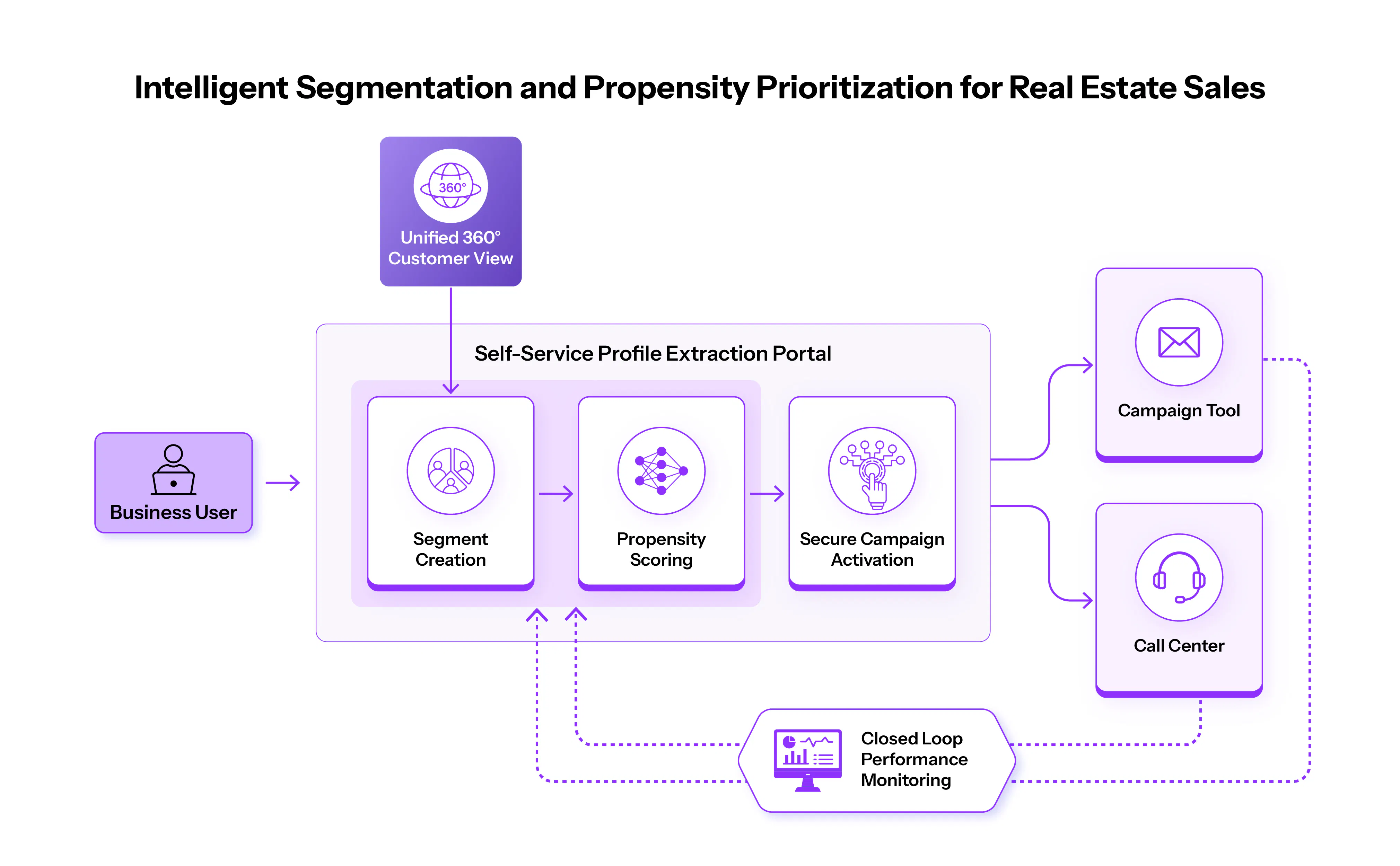
InXiteOut designed and deployed a solution that put targeted segmentation in the hands of business users and digitized the entire path from segment creation to tracked outreach. We began by mapping the client's end-to-end process, across segmentation, campaign execution, and data sharing, then built the solution across four connected components.
Self-Service Profile Extraction Portal
InXiteOut built a guided, access-controlled portal that gave business users complete control over customer segment creation. Through a clean, form-driven interface, they could build sophisticated segments without writing a single query. Prospects could be targeted across demographic, financial, behavioral, and campaign attributes, with live search making it easy to find and apply the right ones.
Segments were then built as a three-layer structure: broad targeting groups at the top, finer sub-segments within them, and exclusions to filter out who to leave off, for instance, a target city, then specific neighborhoods within it, minus prospects outside the project's budget range. Every segment was reusable and auditable, and could be extracted in minutes rather than waiting days on engineering.
Behind the scenes, every selection a user makes is instantly turned into an optimized query and run on the Databricks platform. The engine builds the query, applies the exclusions, and checks everything before it runs, so users get accurate segments in minutes without ever seeing the technical complexity underneath.
Embedded Propensity Intelligence
The client also needed to know which prospects within a segment were most likely to convert for a given project. So, propensity scoring was built directly into the extraction flow, with no separate, offline step: the moment a segment is pulled, every prospect in it is automatically scored for purchase likelihood.
The score is computed for a specific project, so the model weighs two kinds of inputs together: the prospect's own parameters, such as their demographic and financial profile and past engagement, and the project's parameters, such as its location, price point, and property type. The same prospect can score high for one project and low for another, depending on fit. The model was trained on the client's own historical outreach and conversion data, so its scoring reflects how buyers in this market actually behave. As outreach responses come in, the scores are refreshed, and the model learns, sharpening its predictions over time.
With every prospect scored in-line, sales and marketing can focus on the highest-propensity buyers first instead of treating the whole list the same, concentrating effort where conversion is most likely.
Secure Campaign Activation
With prospects already scored and prioritized, the platform sends the high-priority leads directly into the client's campaign execution systems and call-center dialer tools. From there, sales and marketing teams can activate each audience across the right mix of channels, call center outreach, digital campaigns, and other configured touchpoints, based on the campaign strategy for that segment.
The system also guards against data leakage and compliance risk by removing manual exports and email-based data sharing entirely. Additionally, personal details stay masked from the teams running outreach: they work each lead through system-generated IDs, while the dialer and execution tools place calls without ever exposing raw personal data.
Closed-Loop Performance Tracking
To close the loop, InXiteOut built a Power BI suite that gives marketing and campaign teams full visibility into how outreach is performing. It tracks outreach activity and status (calls made, connected, and campaigns sent), the conversion funnel from lead to contact to booked site visit, and performance broken down by segment, project, and channel. It also compares predicted propensity against actual outcomes, showing how well the model's scores held up in the field.
For the first time, teams can measure what is actually working. They can see which segments and channels are converting, and use those insights to refine future segments and campaign strategy. The same results flow back into the propensity model, so each campaign sharpens the scoring for the next one, and the system gets better with every cycle.
Technology Stack Used
- MERN Stack (React.js, Node.js, MongoDB)
- Azure Databricks
- Azure Data Lake Storage Gen2
- ML Propensity Models
- Microsoft Power BI
- Microsoft SSO, Role-Based Access Control
Benefits Delivered
The solution put segmentation in the hands of business users, prioritized the highest-intent buyers automatically, secured the entire data handoff, and made outreach measurable end-to-end, accelerating sales execution while reducing risk.
- 50%+ Faster Segmentation: Business users could build and refine targeted segments themselves, with no engineering dependency. Dynamic query generation cut extraction time by more than half, turning segment builds that once took days into minutes.
- 17% Higher Conversion: Embedded propensity scoring let teams focus on the highest-intent prospects first, improving site-visit conversion by 17% and lifting campaign ROI.
- Faster, Automated Activation: Automated routing from segmentation to campaign execution removed manual handoffs, getting prioritized leads to outreach teams in a fraction of the time.
- Secure, Compliant Data Handling: Replacing manual exports and email sharing with controlled, system-driven access, and masking personal data behind system-generated IDs, closed the compliance gap and eliminated the risk of prospect data leaking during outreach.
- Measurable, Self-Improving Outreach: A Power BI suite gave teams full visibility into outreach performance, from calls made to site visits booked, by segment, project, and channel. Results feed back into the propensity model, so each campaign sharpens targeting for the next.
- Scalable Foundation: The architecture scales with growing data volumes and new AI use cases without major redevelopment, supporting 150+ campaigns across 100+ projects.
Suggested Reads

Decoding the Commercial Vehicle Rejector: How Competitive Intelligence Reshaped an OEM's Strategy
Find out how AI-powered VoC analytics helped a global automotive OEM de-risk a major fuel tank design change, safeguarding sales and improving product decisions.

How VoXLoop Insights Helped Optimize the Early Ownership Experience of a New Lifestyle SUV
Learn how VoXLoop Insights empowered a top automaker to enhance SUV ownership quality, resolve early issues, and deliver a superior lifestyle experience.

Unstructured Voice to Strategic Insight: How InXiteOut Powers an Automotive Leader's Customer-First Strategy
Discover how InXiteOut transformed unstructured voice data into strategic insights, enabling a Fortune 500 automotive leader to accelerate customer-first decisions.