
Share this Blog
How to Anchor GenAI to Business Outcomes: The Outcome-First Framework
Beneath the wave of Generative AI adoption lies a sobering reality: most GenAI initiatives are failing to deliver measurable business value. You’ve likely seen the 2025 MIT study reporting that 95% of enterprise generative AI pilots fail to create measurable P&L impact [1].
There’s more than one reason that often goes wrong. Not anchoring Generative AI initiatives to clear, measurable KPIs arguably is the biggest of them all.
Most organizations start with the technology and then look for problems to solve, rather than beginning with specific business outcomes and working backward to determine where AI can help achieve them.
This is where the Outcome-First Framework comes in. This approach anchors every GenAI initiative to concrete, measurable business outcomes.
In this article, we will cover the five essential steps to anchor GenAI to business outcomes and see practical examples of revenue and cost-focused applications.
What Is the Outcome-First Framework?
The Outcome-First Framework is a strategic approach that begins by defining specific, measurable business outcomes and then determining how GenAI initiatives can help achieve them.
This means asking "What business outcome are we trying to achieve?" before asking "What can AI do?" It prioritizes outcomes (revenue growth, cost savings, customer satisfaction) over outputs (number of queries answered, number of reports produced).
This represents a fundamental shift from the traditional technology-first approach, which has significantly contributed to the high failure rate of Generative AI initiatives.
The Two Pillars: Revenue and Cost Outcomes
The Outcome-First Framework organizes initiatives around two fundamental categories of business impact:
Revenue Outcomes focus on growing the top line through:
- New revenue streams: Creating new products, services, or business models enabled by AI
- Revenue expansion: Increasing sales from existing offerings through better conversion, upsell, or retention
- Market share growth: Capturing a larger portion of existing markets or entering new ones
- Customer lifetime value enhancement: Improving customer experience and satisfaction to drive repeat business
Cost Outcomes target bottom-line improvement through:
- Process automation: Reducing manual effort in repetitive, high-volume tasks
- Labor productivity gains: Enabling employees to accomplish more in less time
- Infrastructure optimization: Reducing technology and operational costs
- Error reduction: Minimizing costly mistakes, rework, and compliance issues
Understanding which pillar aligns with your strategic priorities is critical for success.
According to MIT's analysis, back-office automation often delivers higher returns by streamlining processes, reducing outsourcing, and cutting costs, while most budgets are concentrated in sales- and marketing-focused pilots, where ROI is lower [2].
This suggests that many organizations are pursuing revenue outcomes when cost outcomes would deliver faster, more measurable returns, leading to projects that don’t drive ROI.
Why This Approach Works
The Outcome-First Framework addresses the root causes of GenAI failure by ensuring:
- Clear success criteria from day one: Defining outcomes upfront (e.g., "increase repeat customer revenue by 15%") makes success measurable from day one.
- Better resource allocation: Working backward from outcomes helps you invest in high-impact initiatives instead of spreading resources thin.
- Measurable ROI: Specific outcome definitions enable direct attribution of business results to AI investments, making value undeniable.
- Stakeholder alignment: Pre-agreed outcomes eliminate confusion and misalignment that derail initiatives.
In the old technology-first model, companies might deploy a general-purpose AI copilot across the organization, hoping employees would find valuable use cases.
In the Outcome-First Framework, you would first identify a specific outcome, then select or build the AI tool specifically designed to achieve that outcome.
By starting with outcomes rather than technology, you ensure that every dollar spent on GenAI is tied to a specific business objective.
The 5-Step Outcome-First Framework
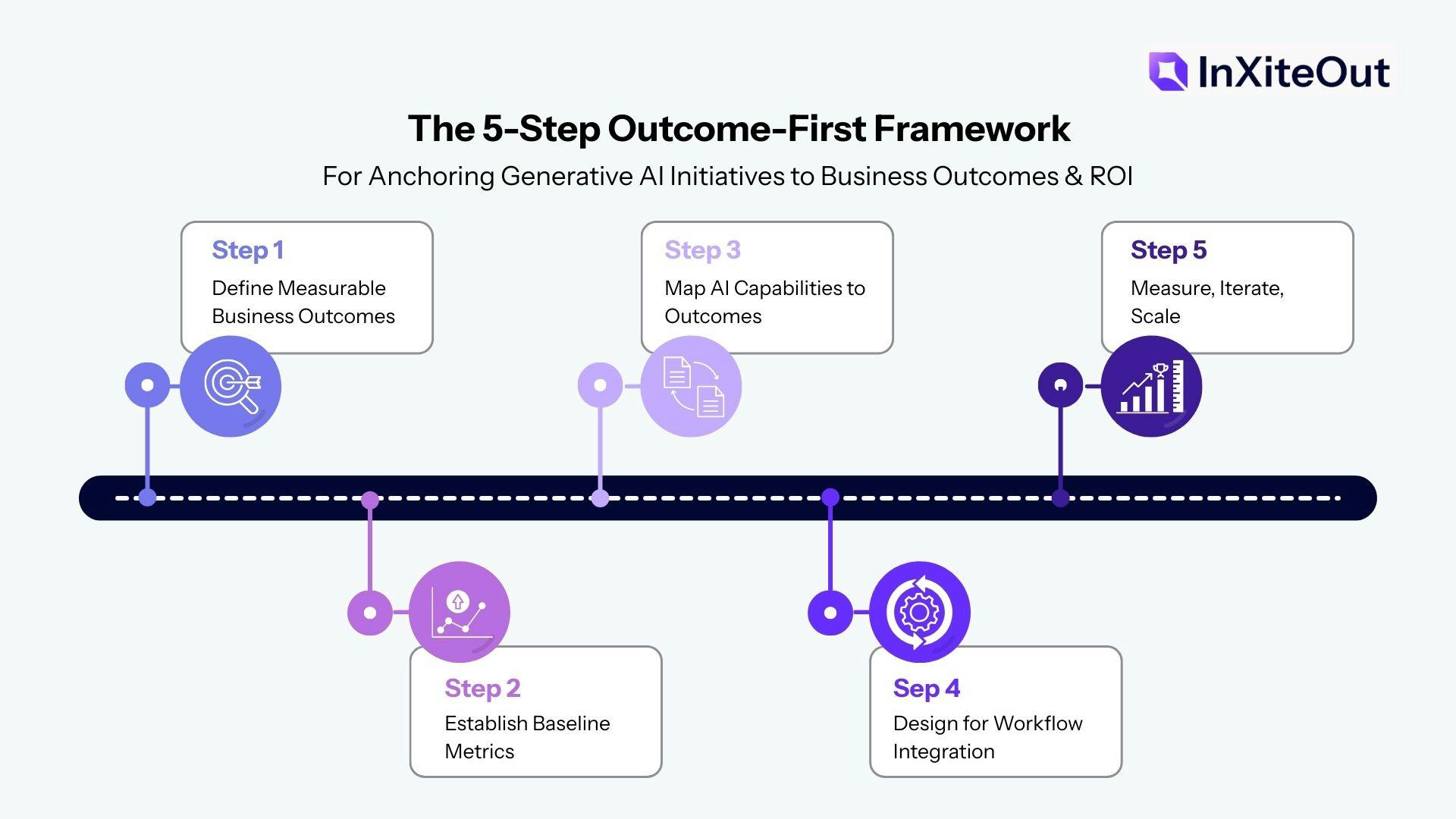
Step 1: Define Measurable Business Outcomes
The first and most critical step is defining exactly what success looks like in concrete, measurable terms. Here are some examples,
- Increase e-commerce conversion from 2.3% to 3.0% (a 30% relative increase) in 3 months.
- Decrease order fulfillment errors from 3.2% to under 1.0% in 4 months.
Why specificity matters: Vague goals lead to vague results. When you can't measure whether you've succeeded, it becomes impossible to justify continued investment or scale the initiative.
Step 2: Establish Baseline Metrics
Before implementing any GenAI solution, you must capture your current performance. Without a baseline, you cannot prove ROI or isolate AI's specific contribution to business improvements.
Three-tier measurement framework:
Tier 1: Business Outcome Metrics: Revenue metrics (MRR, AOV, CAC), Cost metrics, and Customer metrics (CSAT, NPS, CLV) as applicable for your industry.
Tier 2: Operational KPIs: Speed, accuracy, throughput, and efficiency related metrics.
Tier 3: Behavioral Metrics: Adoption rate, engagement frequency, customer satisfaction, etc.
Step 3: Map AI Capabilities to Outcomes
Identifying which AI use cases will actually deliver your desired outcomes, and prioritizing them based on impact and feasibility, is the next step.
The Prioritization Framework: Impact vs. Feasibility
To move from a "list of ideas" to a strategic roadmap, every GenAI use case must be audited against three objective variables. Rate each variable on a scale of 1–10:
- Business Value (V): How much does this move a Tier 1 KPI (e.g., Gross Margin, OpEx, or Churn)?
- Implementation Feasibility (F): Do we have the talent, the right architecture, and a clear path to production —either in-house or through the right partner?
- Data Maturity (D): Is the necessary data accessible, "clean," and legally compliant for AI processing?
The ROI Scoring Formula
By multiplying these factors, you create a Priority Score that allows for an "apples-to-apples" comparison of vastly different projects.
Priority Score = V X F X D / 100
- Scores > 7.0 (Quick Wins): These are high-value, low-friction projects. They should be prioritized to build momentum and "fund" the AI journey.
- Scores 4.0 – 6.9 (Strategic Bets): High-value but high-complexity. These require more significant investment and a longer runway.
- Scores < 4.0 (AI Theater): These projects often look impressive in a demo but lack the data foundation or business impact to justify the cost. Discard or defer these.
That said, only a ‘Quick Wins’ focused enterprise AI strategy isn’t healthy. You need a balanced portfolio to achieve transformational outcomes.
Many organizations fail here because they overestimate Data Maturity (D). If your data is siloed or unvetted, your score will drop, signaling that you need to fix your data pipeline before building the AI layer.
Step 4: Design for Workflow Integration
Even the most sophisticated AI solution will fail if people don't actually use it. Deep workflow integration, embedding AI directly into existing processes where users naturally work, is critical for success.
Users won't switch between five different applications to get their work done. They'll use the path of least resistance, which is usually their existing process without AI.
Complement this with focused adoption drives including training, responsive problem-solving support and accessible technical assistance.
Step 5: Measure, Iterate, Scale
Continuous measurement, rapid iteration based on results, and disciplined scaling criteria are core to successful GenAI initiatives.
Tracking & measurement:
Create dashboards that track all three tiers of metrics (business outcomes, operational KPIs, behavioral metrics) in real-time to ensure accurate GenAI ROI measurement.
Comprehensive visibility enables early detection of issues, rapid identification of what's working, data-driven investment decisions, and clear communication of value.
Additionally, one must benchmark their results against industry standards. For example, companies moving early into GenAI adoption report $3.70 in return for every dollar invested, with top performers achieving $10.30 returns per dollar [3]. These benchmarks provide targets for your own ROI expectations.
Scaling criteria:
Before scaling an AI initiative, verify:
- Validated outcomes: Has the pilot achieved its target business metrics with statistical significance?
- Operational stability: Is the system reliable, maintainable, and performing consistently?
- User satisfaction: Are users actually finding value, or are they using it because they're forced to?
- Cost-effectiveness: Does the ROI justify broader deployment?
- Organizational readiness: Do you have the resources, skills, and processes to scale?

Generative AI Projects by InXiteOut
GenAI Use Case 1: [Read the full Case Study]
Context: A telecom leader was losing customers, and traditional analytics wasn’t enabling timely, preventive action.
Solution: InXiteOut deployed its proprietary GenAI-driven accelerator to convert customer feedback into decision-ready insights.
Business outcome: Reduced churn by 20%, 80% faster Time-to-Insight.
GenAI Use Case 2: [Read the full Case Study]
Context: A multinational market leader sought to transform their global VoC operations to accelerate the growth of their advanced consumer product line.
Solution: InXiteOut delivered an integrated platform combining a customer voice data repository, Generative AI modules for insight generation, and real-time visualization dashboards.
Business Impact: 50% FTE reduction, quick identification of top 3 product issues, faster product upgrades.
Conclusion: From Pilots to Production
While over 80% of companies have explored GenAI tools, fewer than 5% reach production with measurable impact. The Outcome-First Framework offers a way out. By starting with specific, measurable outcomes, organizations achieve higher success rates.
Success isn't measured in AI features deployed, but in business results: revenue increased, costs reduced, customers satisfied. Start with one high-impact outcome and apply the framework rigorously.
If you’re struggling to anchor your GenAI initiatives to real business outcomes, partner with an experienced AI & Analytics firm that can accelerate adoption, apply proven methodologies, and help you avoid costly pitfalls, so you realize true ROI from GenAI.
References:
- MLQ – State of AI in Business 2025 report
- Fortune – MIT report on GenAI pilots
- Microsoft/IDC – GenAI ROI report
Author

Read More

AI in Retail: How Leading Brands Use AI for Customer Segmentation and Personalization
Discover how AI is redefining retail by making customer segmentation and personalization more dynamic, data-driven, and scalable than ever before.

Customer Segmentation Models and How AI is Enhancing Them
Explore 8 customer segmentation models — from RFM and behavioral to psychographic and AI-powered — with real brand examples and how AI makes segmentation smarter.

Data Mesh vs. Data Fabric: Key Differences, Use Cases, and How to Choose
Explore how data mesh and data fabric compare in modern data architecture. Learn which approach suits your business needs, supports AI readiness, and helps you implement scalable, secure data strategies.
Sign up for our newsletter
Don't miss our latest AI & Analytics updates
We respect your privacy. Unsubscribe at any time.