
Share this Blog
How to Evaluate a Databricks Consulting Partner: 10 Questions to Ask
Choosing the right Databricks consulting partner can significantly influence the value you derive from your data and AI investments. A strong partner helps you design a scalable data architecture, implement Databricks effectively, and build a trusted data foundation for analytics and AI workloads.
To evaluate a Databricks consulting partner, start by verifying their status in the Databricks Partner Directory. Next, assess their business impact, Databricks experience, and expertise with the latest capabilities. Then consider their fit with your business, industry experience, delivery methodology, governance and cost-optimization practices, GenAI readiness, reusable accelerators, and post-go-live support. A service provider's Databricks Partnership page is typically a good place to find most of this information.
InXiteOut is a Databricks Consulting and System Integrator partner. Drawing on our experience delivering Databricks solutions in production, here are the 10 questions we believe every business should ask when evaluating a Databricks partner.
1. What Business Value Have They Delivered with Databricks?
Databricks expertise should ultimately be measured by what it delivers to the business. When evaluating a Databricks consulting partner, ask for measurable outcomes, backed by case studies across three areas. A strong partner should be able to demonstrate how the solutions they have built on Databricks have helped organizations:
- Increase revenue by improving customer targeting, personalization, forecasting, pricing, or sales effectiveness.
- Reduce costs by automating manual processes, optimizing data and analytics workloads, reducing infrastructure overhead, or improving operational efficiency.
- Accelerate decision-making and operations by bringing data together, reducing data latency, automating workflows, and making insights available when the business needs them.
At InXiteOut, we believe technology is only the enabler. The real measure of a Databricks engagement is its impact on the business. A capable Databricks consulting partner should therefore be able to deliver clear business results.
2. How Deep and Current Is Their Databricks Experience?
A Databricks partner’s experience matters most when it has been tested in real enterprise environments. Ask how long they have worked with Databricks, how many solutions they have taken into production, and at what scale. Successful pilots are a start, but production deployments that serve business-critical use cases are the real proof.
Experience also needs to be current. Databricks is now an end-to-end data and AI platform spanning engineering, analytics, governance, machine learning, and Agentic AI. Hands-on expertise with these newer capabilities keeps your data and AI workloads future-proof.
InXiteOut brings both. We have more than six years of Databricks experience across Fortune 500 brands and mid-sized enterprises, with solutions built on the platform’s latest capabilities running in production at global scale.
3. Is the Partner the Right Fit for Your Business?
The largest or best-known Databricks partner is not necessarily the best partner for your business. Look for one whose scale, approach, and way of working match your needs.
Factors such as accessibility of senior experts, level of involvement, speed of decision-making, flexibility, and willingness to work closely with internal teams can be just as important as technical expertise.
The right partner should be invested in understanding where your business is today, where you want to go, and what it will take to get there. They should be able to meet you at your current scale while having the expertise to support you as your data and AI needs evolve.
At InXiteOut, we bring a high degree of ownership and attention to every engagement. We work as an extension of our customers' teams, bringing the right expertise to the problem while remaining accessible and closely involved throughout the journey.
4. Do They Have Relevant Industry and Use Case Experience?
Relevant industry and use case experience helps a partner quickly understand your business challenges and recommend the right solution. Look for a partner that has solved problems like yours in your industry. For example:
- Retail & CPG: Demand forecasting, customer 360, and personalization
- Real Estate: Sales intelligence, lead segmentation, customer analytics, and conversion optimization
- Automotive: Voice of Customer (VoC) analytics, product insights, and product roadmap intelligence
- BFSI: Process automation, risk modeling, fraud detection, and regulatory analytics
A partner with deep industry experience doesn't start from scratch. They already understand the data sources your business runs on, how that data should be structured and modeled, which use cases tend to deliver measurable results, and what it takes to operationalize a solution so the business actually adopts it.
At InXiteOut, we have delivered Databricks solutions in production across each of these industries.
5. What Is Their Databricks Implementation and Delivery Methodology?
A credible Databricks partner should start by evaluating the use case for business impact, then deliver the solution in three clear phases:
- Phase 1 – Assess: An assessment of your data estate in the context of the target use case, producing a target architecture, a development roadmap, and a realistic projection of Databricks Unit (DBU) and broader cloud costs.
- Phase 2 – Prove: An MVP with governance built in, run against a representative subset of your real production data to validate feasibility and surface data quality issues early.
- Phase 3 – Scale: Full solution development and production hardening, followed by enterprise-wide adoption support.
The Prove phase is where methodologies differ most. A pipeline that runs on clean sample data proves far less than one that ingests data from your actual source systems, whether Hadoop, Snowflake, Teradata, or a patchwork of on-premises platforms. Building governance in at this stage also avoids costly rework later.
At InXiteOut, we structure all our Databricks engagements around this Assess, Prove, Scale sequence.
6. How Do They Approach Data Governance and Security on Databricks?
Many Databricks projects run into trouble because governance is treated as an afterthought and bolted onto an architecture that was never designed for it. A governance-first partner builds it into the Unity Catalog structure from day one, covering:
- Unified access management across data, models, and other assets
- Fine-grained, policy-driven security, including row- and column-level controls and data masking
- Regulatory alignment and auditability for your specific industry
- End-to-end data and model lineage, including relevant external assets
Ask how they implement access controls. Policy-driven controls that scale automatically as new tables are added are far easier to maintain than manual table-by-table grants, and they reduce audit risk as your platform grows.
At InXiteOut, governance is designed into every Databricks architecture we build, not added after go-live.
7. How Do They Manage and Optimize Databricks Costs?
Databricks cost optimization is where many engagements lose their ROI. Costs often climb within the first few months after go-live, once ad hoc usage replaces the carefully tuned MVP environment.
A strong partner builds cost optimization into its delivery framework. Look for one that:
- Uses the right compute: Chooses serverless or jobs compute where appropriate, instead of defaulting to all-purpose compute.
- Sets cost controls: Applies compute policies, budgets, and alerts to prevent unnecessary consumption.
- Provides cost visibility: Uses tagging and system tables to track usage and pinpoint cost drivers.
- Optimizes continuously: Reviews workloads after go-live to reduce waste and improve efficiency.
At InXiteOut, cost optimization runs through every engagement, from the DBU projection in the Assess phase to ongoing reviews after go-live. To learn why Databricks costs escalate and how much of that spend can typically be reclaimed, see our Databricks FAQs.
8. What Is Their Approach to Generative AI and Agentic AI on Databricks?
Databricks now offers a full stack for building Generative AI and Agentic AI on your governed enterprise data. Yet many enterprises remain stuck at experimentation. A strong partner knows how to use this stack to take the right use cases into production.
Ask whether the partner can:
- Identify the right use cases: Pinpoint where GenAI or agentic workflows solve real business problems and deliver measurable value.
- Build on your data foundation: Ground AI applications in your lakehouse data through retrieval-augmented generation (RAG) with Databricks AI Search, so responses draw on governed, up-to-date context.
- Deliver production-ready solutions: Build agents with Agent Bricks or custom frameworks that are scalable, reliable, observable, and cost-efficient.
- Govern AI and agents: Extend Unity Catalog controls to models, agents, and the tools they access, before anything reaches production.
- Measure and improve performance: Use MLflow evaluation and tracing to monitor response quality, accuracy, latency, and cost as AI usage scales.
At InXiteOut, we build GenAI and agentic solutions natively on Databricks, taking them from use-case selection to production with governance and evaluation built in.
9. Do They Have Databricks Accelerators That Speed Up Delivery?
Not every Databricks solution needs to be built from scratch. Experienced partners bring pre-built accelerators, frameworks, and reusable components that adapt to your use case, cutting development effort, timelines, and project costs. Ask whether their accelerators are Databricks-native, proven in production, and configurable to your environment. Generic templates that need heavy rework save little.
At InXiteOut, our accelerators give every engagement a head start. Crucible, our agentic, Databricks-native ETL accelerator, builds AI-ready data foundations that are secure and governed by design. Its agents assist with setup, monitor every run, and validate data quality, so you get trusted data, faster.
10. How Do They Support You After Go-Live?
Going live is only the start. After go-live, a Databricks platform has to keep pace with new data sources, growing user demand, and regular platform updates, without disrupting the business. A partner's role shouldn't end at handover.
Ask whether the partner offers:
- Proactive monitoring and support: Monitoring of pipelines, jobs, and performance under clear SLAs, rather than a reactive ticket queue.
- Knowledge transfer and training: Hands-on enablement and documentation, so your team can run and extend the platform on its own.
- Continuous improvement: Regular reviews of performance, cost, and new Databricks capabilities that could benefit your workloads.
- A flexible support model: Support that scales up or down as your needs and in-house capability change.
At InXiteOut, we offer managed services, team training, or a hybrid of the two, depending on each customer's needs, scale, and maturity. That way, you get the right level of support as your platform and your team grow.
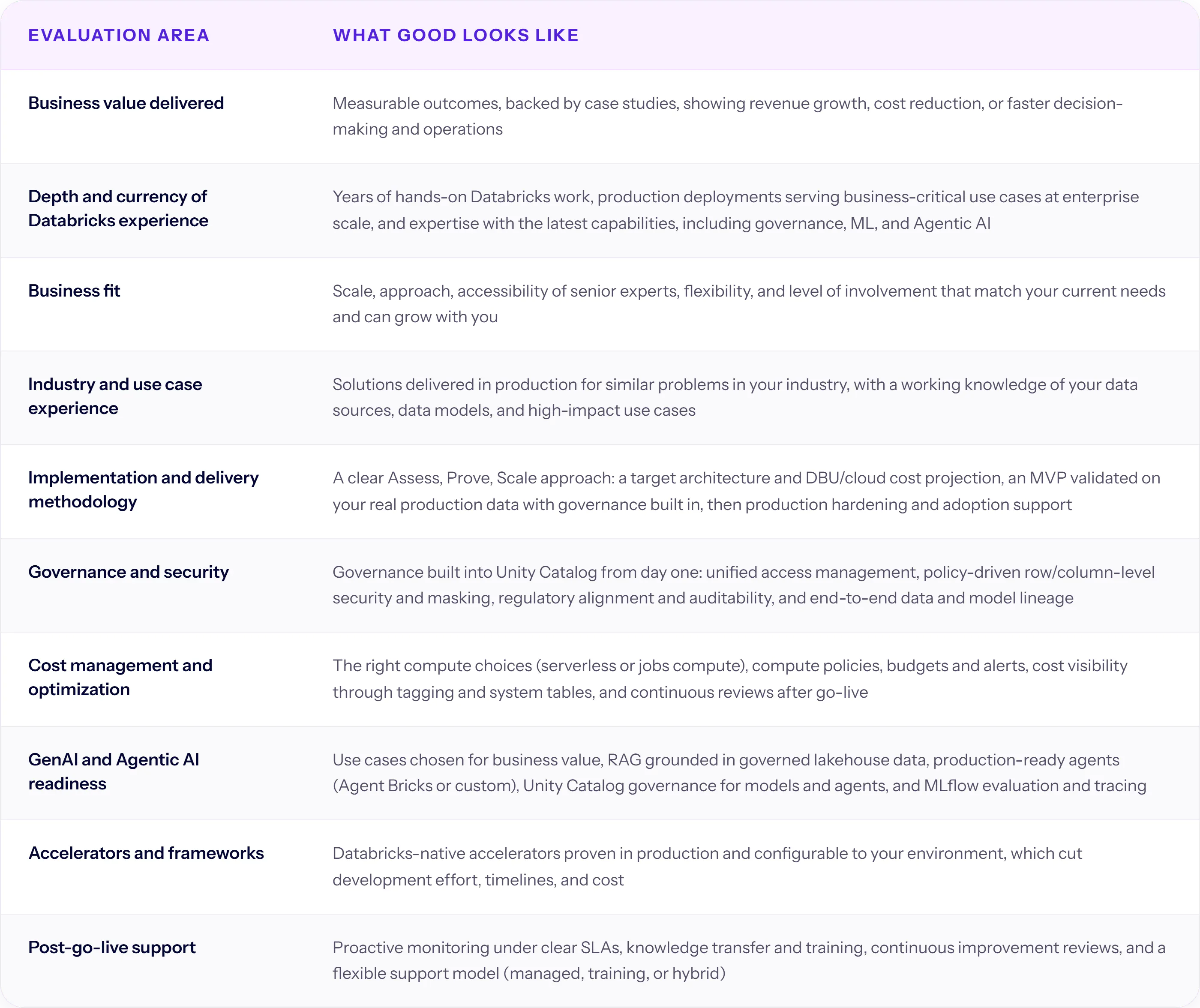
A Quick Scorecard for Evaluating Databricks Partners
Use this Databricks partner checklist as a working reference when evaluating shortlisted firms.
Frequently Asked Questions
Q: What is the Databricks Partner Directory?
The Databricks Partner Directory is Databricks' official listing of its consulting and system integrator partners. Use it to confirm that a firm is a recognized Databricks partner and to check its tier and specializations. Treat it as a first filter. Once a firm's standing is verified, use the questions in this guide for deeper due diligence.
Q: What do Databricks partner tiers like Bronze, Silver, Gold, and Platinum mean?
Databricks groups partners in its Brickbuilder Partner Network into four tiers. A partner’s tier reflects its certifications, customer delivery evidence, and validated specializations. Higher tiers signal broader scale and program participation, but they don’t automatically mean a better fit for your project. Treat tier as one input alongside specializations, delivery track record, and team expertise, and weigh it against the fit factors in Question 3.
Q: How long does a typical Databricks implementation take?
Timelines depend on scope, data complexity, and the number of source systems involved. Each phase of the Assess, Prove, Scale approach described in Question 5 has its own timeline, and Databricks-native accelerators (Question 9) can shorten delivery significantly. InXiteOut’s Crucible, for example, cuts the time to build a data foundation on Databricks by about 40%.
Q: Does a Databricks partner need generative AI and agentic AI experience?
Yes. Organizations are moving fast to build agentic applications. Databricks’ 2026 State of AI Agents report, drawn from more than 20,000 organizations, found that multi-agent workflows grew 327% in just four months. These applications depend on three things: a trusted data foundation, strong governance, and a framework for building and running agents. Your partner should have production experience across all three. Question 8 covers what to ask for agentic and generative AI experience.
Choosing the Right Databricks Partner with Confidence
The right Databricks partner earns your confidence through specifics: measurable business outcomes, current production-proven expertise, a disciplined delivery approach, and support that continues after go-live. Start by verifying a firm on the Databricks Partner Directory. Then use these 10 questions to find a partner that fits your business today and can grow with your data and AI ambitions. To see how InXiteOut measures up, talk to our Databricks team.
Author

Read More

AI in Retail: How Leading Brands Use AI for Customer Segmentation and Personalization
Discover how AI is redefining retail by making customer segmentation and personalization more dynamic, data-driven, and scalable than ever before.

Customer Segmentation Models and How AI is Enhancing Them
Explore 8 customer segmentation models — from RFM and behavioral to psychographic and AI-powered — with real brand examples and how AI makes segmentation smarter.

Data Mesh vs. Data Fabric: Key Differences, Use Cases, and How to Choose
Explore how data mesh and data fabric compare in modern data architecture. Learn which approach suits your business needs, supports AI readiness, and helps you implement scalable, secure data strategies.
Sign up for our newsletter
Don't miss our latest AI & Analytics updates
We respect your privacy. Unsubscribe at any time.