Share this Blog
From Generative AI to Agentic AI: ROI, Use Cases, and Enterprise Strategy
The last two years have felt like a sprint. If you’re a business leader, you’ve likely overseen a dozen "Generative AI" pilots. You’ve seen the bots that can summarize a 50-page PDF in seconds or a coding assistant for your developers. But as the initial "wow" factor fades, a harder question is emerging in boardrooms: Where is the measurable return on investment?
While Generative AI has been brilliant at democratizing access to information, it has largely remained a "passive" tool. It waits for a human to prompt it, it provides a response, and then it stops. The burden of execution—actually taking that information and doing something with it—still falls entirely on your team.
This is where the conversation is shifting. We are moving from the era of "Passive Generation" to the era of "Autonomous Agency." The transition from generative AI to agentic AI isn't just a technical upgrade; it is the bridge between AI as a novelty and AI as a high-margin business driver.
For an AI, data science and analytics partner like us, this evolution represents the ultimate opportunity to deliver what our clients actually want: not just better words, but better outcomes.
What is the core difference between Generative AI and Agentic AI: Intelligence vs. Agency
In our work building data pipelines and ML models, we categorize the evolution in terms of agency.
Generative AI is a "thought partner." It’s an engine that requires a human in the driver’s seat for every turn. The value is captured in the seconds or minutes saved on a specific cognitive task.
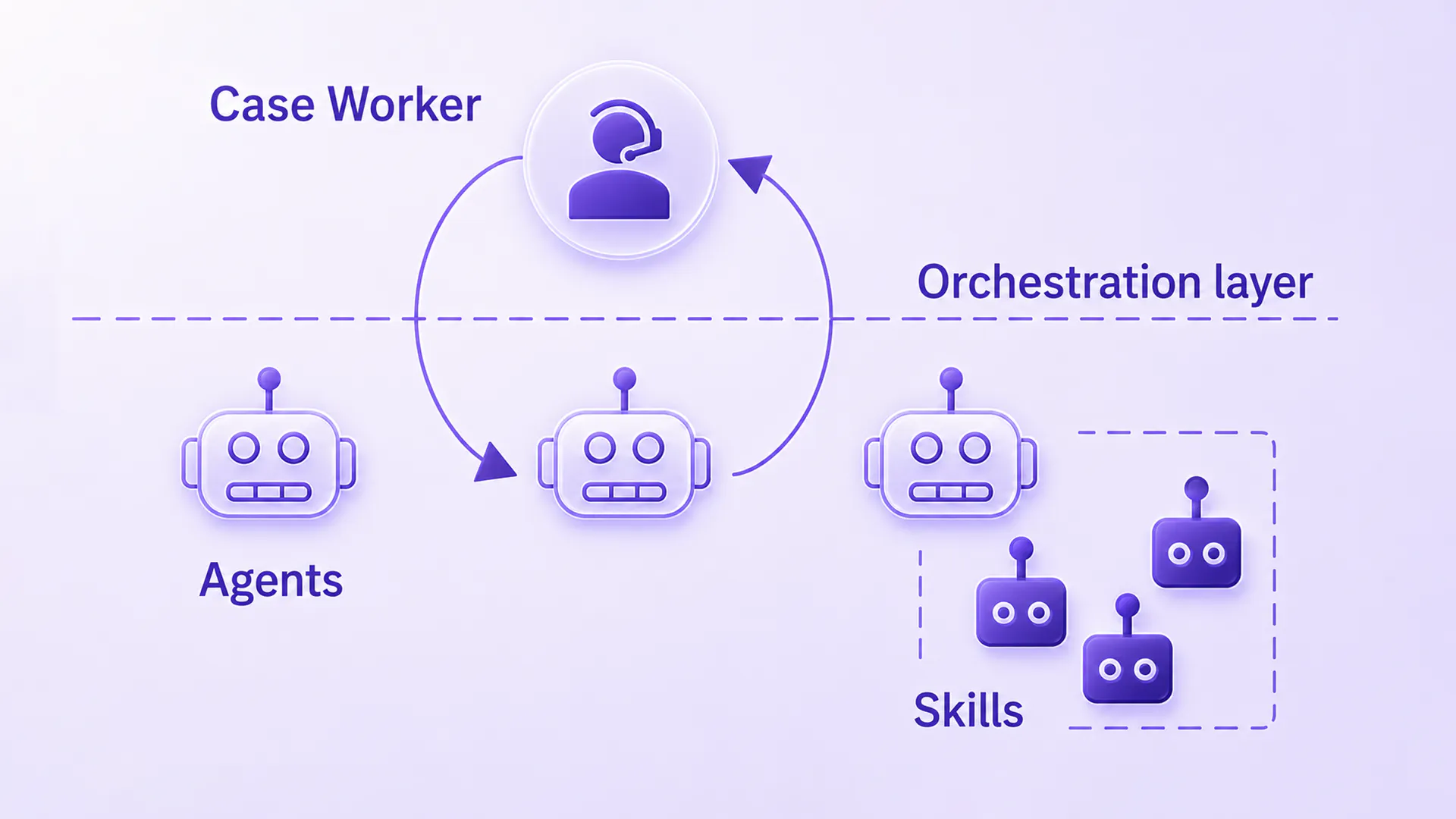
Agentic AI, on the other hand, is a "functional partner." It uses the same LLM "brain," but we wrap it in an orchestration layer that allows it to use tools, access databases, and make decisions within a framework. If GenAI is the engine, Agentic AI is the self-driving car. It doesn't just tell you how to get to your destination; it navigates the traffic, adjusts for road closures, and actually arrives.
Generative AI vs. Agentic AI: Key Differences
To understand the agentic AI business value, we first need to define what makes an "Agent" different from a "Model."
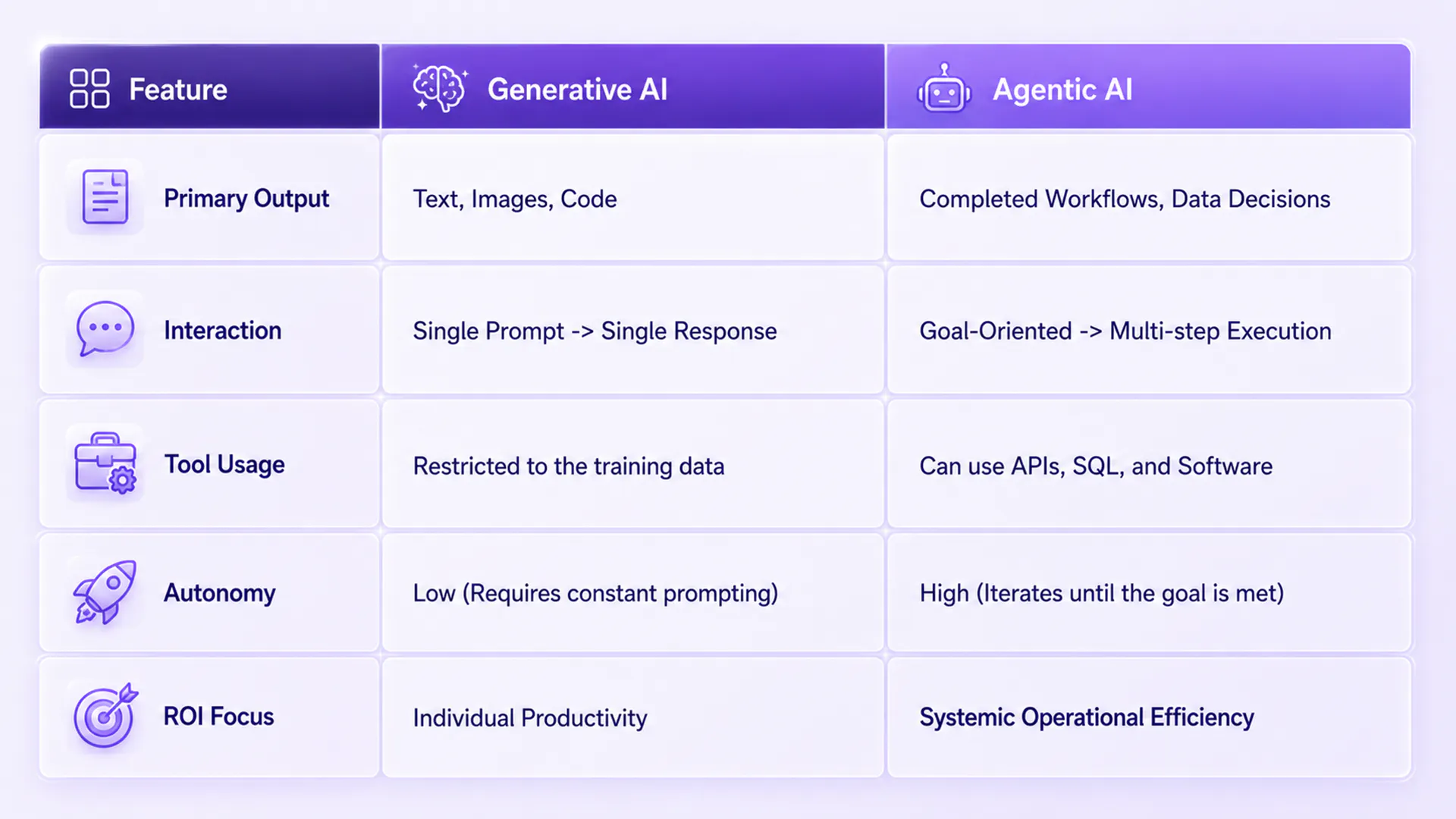
Generative AI Vs. Agentic AI: Features
Generative AI produces text, images, and code that a human then acts upon. Agentic AI delivers completed workflows and data decisions, making it an executor rather than just a content generator.
Where Generative AI works on a single prompt to single response basis, Agentic AI is goal-oriented, breaking objectives into multiple steps and executing them without human input at each stage.
Generative AI is restricted to its training data. Agentic AI actively uses APIs, SQL databases, and external software to retrieve live data and interact with your existing business systems.
In terms of autonomy, Generative AI requires constant prompting while Agentic AI iterates independently until the goal is met.
The ROI focus shifts too — from individual productivity with Generative AI to systemic operational efficiency with Agentic AI, automating entire workflows end to end.
Generative AI Vs. Agentic AI: Features Comparison Table
Generative AI Vs. Agentic AI: Capabilities
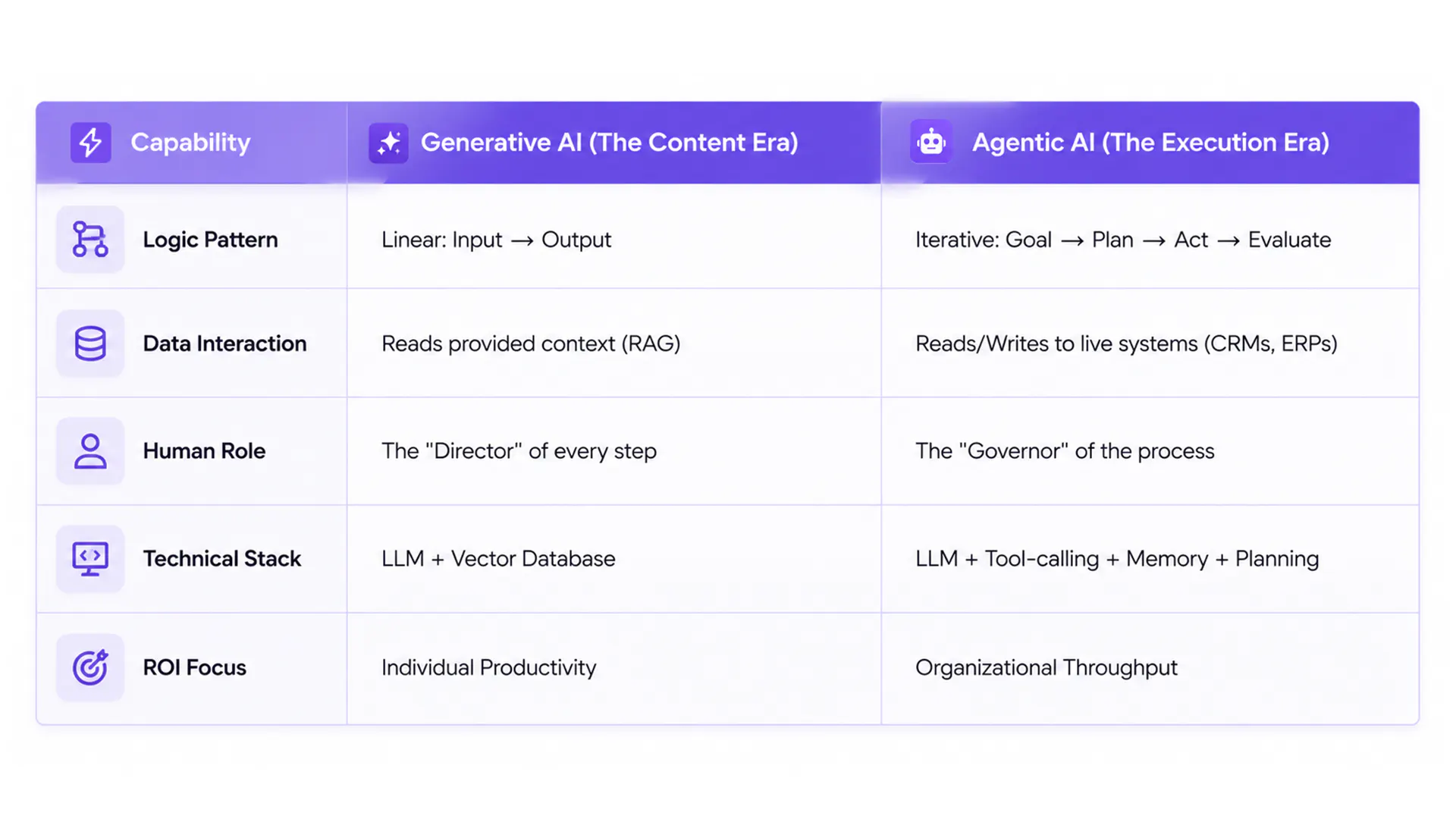
Generative AI follows a linear logic pattern — Input → Output — completing one step at a time. Agentic AI is iterative, cycling through Goal → Plan → Act → Evaluate until the task is done correctly.
Generative AI reads provided context. Agentic AI goes further, reading and writing directly to live systems like CRMs and ERPs.
The human role shifts too. With Generative AI, humans are the Director of every step, guiding each action. With Agentic AI, humans become the Governor of the process, setting boundaries and oversight rather than driving each decision.
At the technical level, Generative AI runs on an LLM plus a vector database. Agentic AI adds tool-calling, memory, and planning layers on top of the same LLM foundation.
The ROI focus moves from individual productivity in the Generative AI to organizational throughput in the Agentic AI.
Generative AI Vs. Agentic AI: Capabilities Comparison Table
Why the evolution from generative AI to agentic AI matters for Your ROI
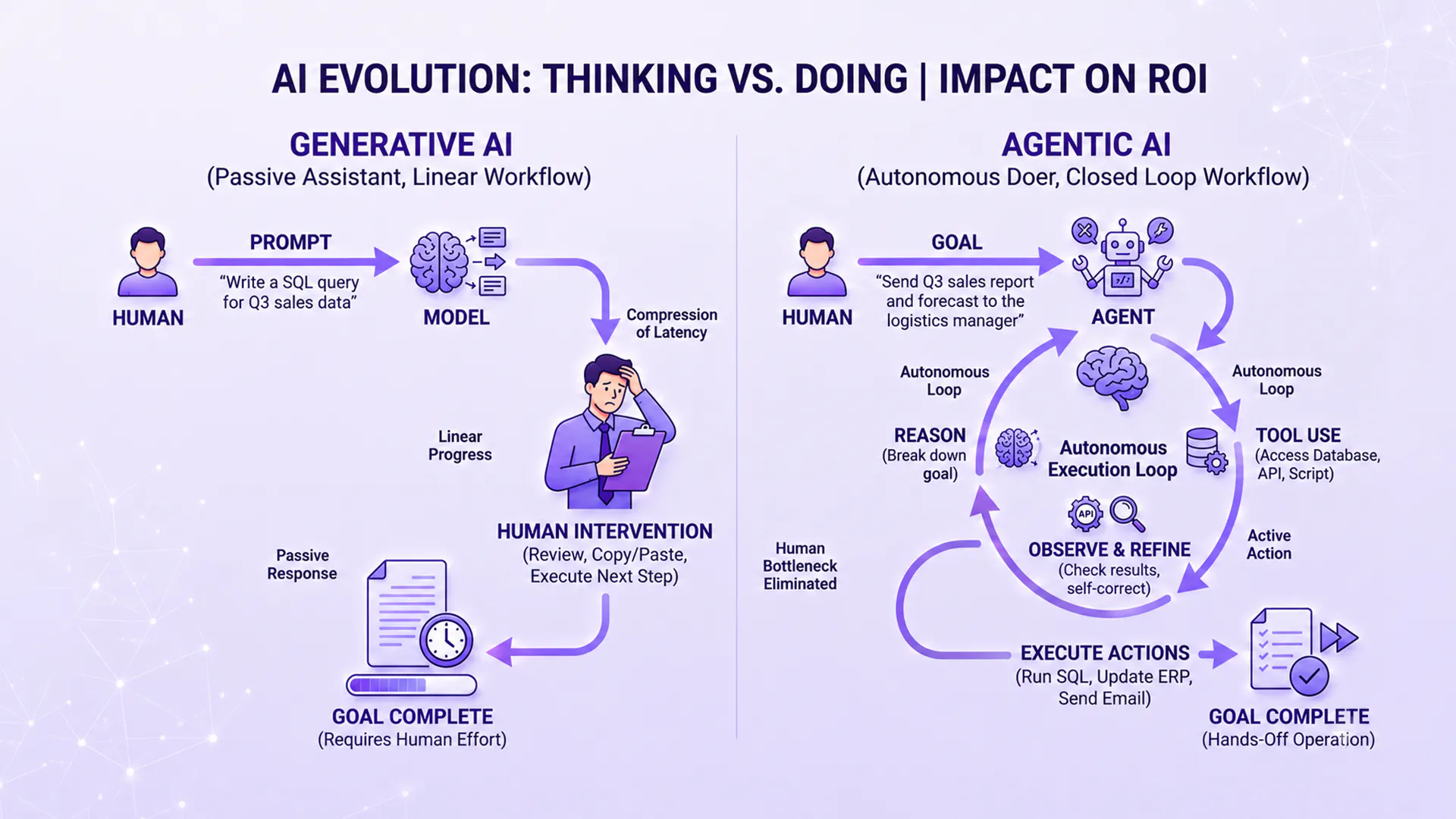
When we consult with clients on their enterprise agentic AI strategy, we focus on three specific levers that directly impact the bottom line: Compression of Latency, Accuracy through Iteration, and Scalable Decision-Making.
1. Compression of Latency
In a standard generative workflow, a human must prompt the AI, check the result, copy-paste that result into another system, and then trigger the next step. The "human-in-the-loop" is often the biggest bottleneck.
Agentic systems eliminate these "air gaps." An agentic system for a supply chain company doesn't just "summarize" a delay report; it recognizes the delay, queries the shipping database for alternatives, calculates the cost impact of a re-route, and drafts the approval request for the logistics manager. The agentic AI ROI here is found in the hours of manual coordination saved every single day.
2. Accuracy through Self-Correction
One of the biggest risks to ROI in Generative AI is "hallucination." If a chatbot gives a wrong answer and a human doesn't catch it, the cost of that error can be massive.
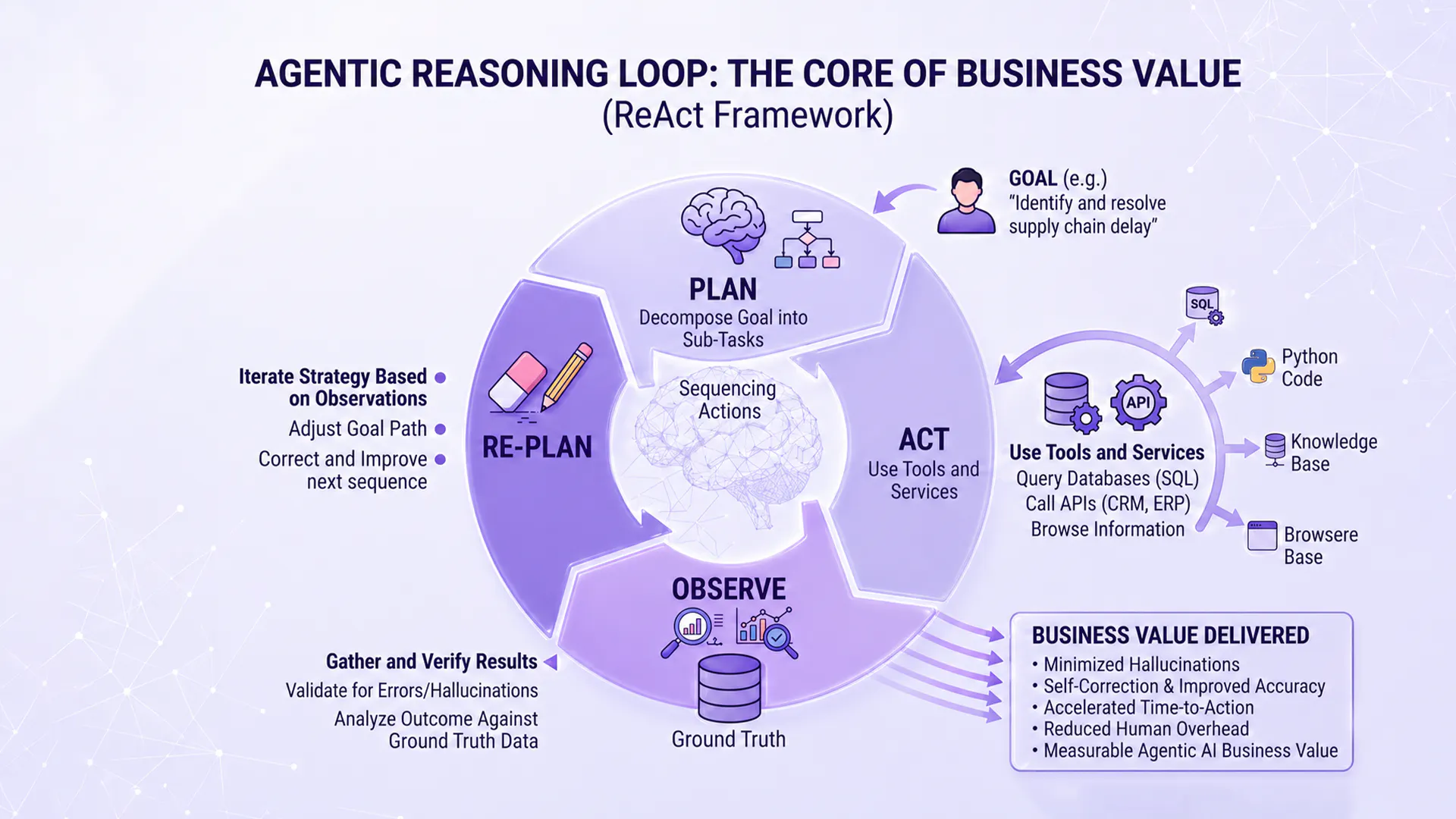
Agentic AI uses a "reasoning loop." It can be programmed to check its own work against a set of ground-truth data (like your company’s SQL databases) before it ever presents a result. This internal validation significantly lowers the risk profile of deploying AI in mission-critical environments like financial forecasting or medical data analysis.
3. Scalable Expertise
Most companies have a "knowledge silo" problem — a few senior analysts who understand the nuances of the data. Agentic AI allows you to codify that expertise. By building agents that follow the same logical steps as your best analysts, you can scale expert-level decision-making across the entire organization without linearly increasing your headcount. We focus on optimizing the "Logic-to-Cost" ratio using smaller, cheaper models for simple steps and reserving the "heavy-hitter" models for the final decision-making.
How to Transition from Generative AI to Agentic AI: 4 Key Pillars
Moving from generative AI to agentic AI isn't as simple as flipping a switch. It requires a sophisticated "Agentic Architecture." As a service-based firm specializing in AI and analytics, we see four critical pillars that define a successful transition.
Pillar 1: The Data Foundation (Engineering is Everything)
An agent is only as good as the tools it can access. If your data is trapped in siloed, messy legacy systems, an agent will fail. The first step in any enterprise agentic AI strategy is robust data engineering. We focus on building "API-first" data environments where an AI agent can securely query real-time data, perform time series forecasting, and pull historical trends without human intervention.
Pillar 2: Tool Use and Environment Design
To deliver true agentic AI business value, the AI needs "hands." This means giving the model access to specific tools—Python environments for data analysis, SQL clients for database management, or even web browsers for market research. Our role is to build these secure "sandboxes" where agents can operate safely. We implement strict Identity and Access Management (IAM) for AI agents, ensuring they operate within a "least privilege" environment.
Pillar 3: Multi-Agent Orchestration
The most complex business problems aren't solved by one person; they are solved by teams. The same is true for AI. The future of ROI lies in "Multi-Agent Systems," where one agent focuses on data retrieval, another on analytical modelling, and a third on quality assurance.
Pillar 4: The Reasoning Framework
We use frameworks like ReAct (Reason + Act) or Chain-of-Thought to ensure the AI doesn't just "guess" the next word, but actually plans its steps.
The ROI Comparison: GenAI vs. Agentic AI
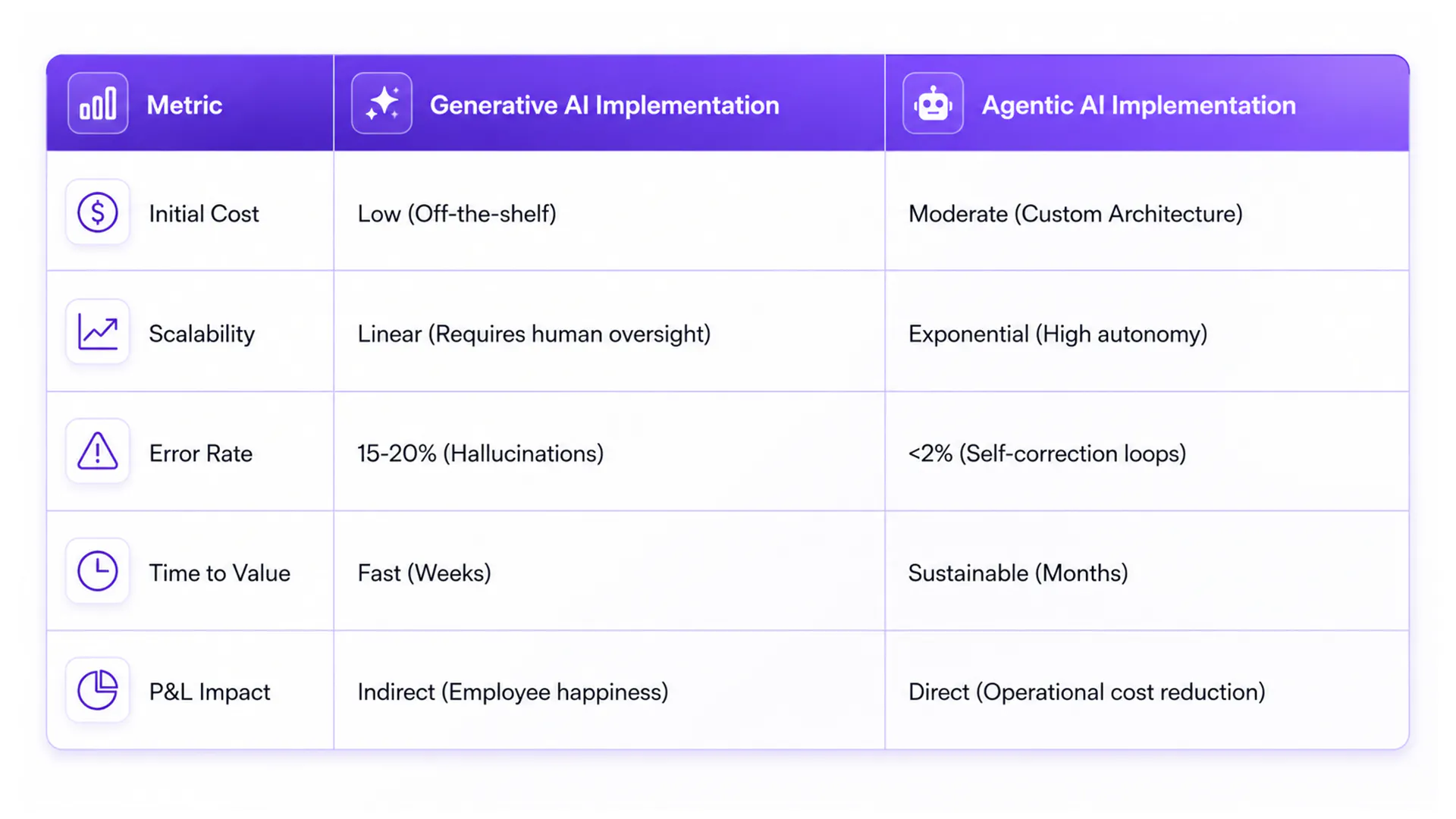
Generative AI has a low initial cost. Most implementations rely on off-the-shelf tools. Agentic AI requires moderate upfront investment due to the custom architecture needed to build and orchestrate autonomous workflows.
Generative AI scales linearly because human oversight is required at each step. Agentic AI scales exponentially, with high autonomy meaning more work gets done without proportionally more people.
The error rate gap is significant. Generative AI carries a 15-20% error rate driven by hallucinations. Agentic AI brings that below 2% through self-correction loops that validate outputs before they reach a human.
Generative AI delivers fast results. Typically within weeks. Agentic AI takes longer to implement, measured in months, but the value it delivers is sustainable and compounding rather than a one-off productivity gain.
Finally, the P&L impact is where the two diverge most clearly. Generative AI's impact on the bottom line is indirect, primarily through improved employee happiness and productivity. Agentic AI delivers direct P&L impact through measurable operational cost reduction.
The ROI Comparison Table: GenAI vs. Agentic AI
Real-World Agentic AI ROI — Applications in Data, Forecasting, and ML
To see how agentic AI ROI manifests, let's look at how we apply this across our core service offerings:
1. Data Analysis and Engineering
The Generative Way: An analyst asks a chatbot to write a SQL query. The analyst runs the query, finds an error, and asks the AI to fix it.
The Agentic Way: An "Analytics Agent" is given a natural language goal: "Find the top 5 reasons for customer churn in Q3." The agent writes the SQL, executes it, sees that a table is missing a join, finds the correct table, re-writes the query, visualizes the data, and delivers a finished report.
Business Value: A 70% reduction in time-to-insight for non-technical stakeholders.
2. Time Series Forecasting
The Generative Way: An AI describes what a "seasonal trend" looks like in a chart.
The Agentic Way: A "Forecasting Agent" monitors live sales data. When it detects a deviation from the predicted trend, it automatically pulls external data (weather, economic shifts, or competitor pricing), re-runs the ML model, and updates the inventory orders in the ERP system.
Business Value: Lowering inventory carrying costs by reacting to market shifts in minutes rather than weekly review cycles.
3. ML Models and AI Solutions
The Generative Way: A model that classifies customer sentiment.
The Agentic Way: A "Customer Success Agent" that identifies a frustrated customer (Sentiment), looks up their lifetime value (Data Analysis), checks the refund policy (Knowledge Retrieval), and issues a personalized discount code automatically (Action).
Business Value: Direct impact on Customer Lifetime Value (CLV) and retention rates.
Developing Your Enterprise Agentic AI Strategy
If you are ready to move to the next level of Generative AI, your enterprise agentic AI strategy should follow a structured roadmap:
- Identify High-Friction Workflows: Look for tasks where your experts are currently acting as "data glue", moving information from one system to another.
- Audit Your Data Readiness: Is your data accessible via API? Is it clean? Agentic AI requires "machine-readable" truth.
- Define Agentic Boundaries: What actions are you comfortable with an AI taking autonomously? What requires a signature?
- Prototype and Iterate: Start with one "Vertical Agent", perhaps a "Data Engineering Agent" that automates your ETL pipelines, and measure the time saved.
The agentic AI business value isn't found in the AI’s ability to mimic human speech; it’s found in its ability to mimic human competence.
Frequently Asked Questions
1. What is the difference between generative AI and agentic AI?
Generative AI is a passive tool — it responds to prompts and stops. Agentic AI is an autonomous system that takes a goal, plans the steps needed to achieve it, uses tools like APIs and databases, checks its own work, and executes until the task is complete.
2. What kind of ROI can enterprises expect from agentic AI?
The ROI from agentic AI comes through three levers: compression of operational latency by eliminating the manual steps between AI outputs and business systems, accuracy improvement through self-correction loops that reduce the cost of errors in mission-critical workflows, and scalable expertise that codifies your best analysts' decision-making across the organization without increasing headcount.
3. How do I start building an enterprise agentic AI strategy?
Start by identifying your highest-friction workflows — tasks where your team is manually moving data between systems. Audit whether your data is API-accessible and machine-readable, define what actions the AI can take autonomously versus what requires human approval, then prototype with a single vertical agent before scaling. InXiteOut's data and AI team can help you assess readiness and build the architecture from the ground up.
Conclusion: The New Standard for ROI
The "Wait and See" approach to AI is becoming increasingly expensive. Every month spent in manual, disjointed GenAI pilots is a month of lost operational efficiency.
The transition from generative AI to agentic AI is where the real business value lives. It is the move to "AI as an infrastructure." As your partner in AI and Data Analytics, our focus is on ensuring that this transition is seamless, secure, and, above all, profitable.
The goal isn't just to have the smartest AI. The goal is to have the most effective business in the market. Agentic AI is how you get there.
Author

Read More

AI in Retail: How Leading Brands Use AI for Customer Segmentation and Personalization
Discover how AI is redefining retail by making customer segmentation and personalization more dynamic, data-driven, and scalable than ever before.

Customer Segmentation Models and How AI is Enhancing Them
Explore 8 customer segmentation models — from RFM and behavioral to psychographic and AI-powered — with real brand examples and how AI makes segmentation smarter.

Data Mesh vs. Data Fabric: Key Differences, Use Cases, and How to Choose
Explore how data mesh and data fabric compare in modern data architecture. Learn which approach suits your business needs, supports AI readiness, and helps you implement scalable, secure data strategies.
Sign up for our newsletter
Don't miss our latest AI & Analytics updates
We respect your privacy. Unsubscribe at any time.