
Share this Blog
The Hidden Tax Killing Your GenAI ROI: Integration Chaos
Why your GenAI stack generates insights but not outcomes, and what an integrated AI architecture actually looks like
The Real Problem Isn’t Your Model
Enterprises have poured billions into Generative AI over the past two years, and many are not getting the returns they expected. Internal copilots are running. Customer support bots are deployed. Sales teams have AI-generated summaries. Adoption metrics look healthy on paper.
But when leadership evaluates actual business impact, a stubborn pattern emerges: Generative AI is producing intelligence that nobody is acting on.
The culprit is rarely the model. It’s integration, or the lack of it. In most enterprises, GenAI systems operate in isolation from core business systems, live data, and operational workflows. They generate outputs that sit in dashboards, get copied into spreadsheets, or get ignored entirely.
As a result, Generative AI remains an assistive tool rather than a transformative capability. And every day that gap persists, it costs real money.
The Integration Tax: What It’s Actually Costing You
McKinsey estimates that fewer than 30% of AI pilots successfully scale to production. The common thread across failed and stalled deployments is most often the architecture.
Disconnected GenAI deployments impose a hidden tax across the enterprise:
- Manual transfer overhead: Teams copy AI-generated outputs into CRM systems, tickets, or reports by hand, adding latency and human error at every step.
- Delayed decision cycles: Insights that arrive 24 hours after an event (a churn signal, a sales trigger, a support escalation) are often too late to act on.
- Wasted inference spend: Models running on outdated, siloed, or low-quality data produce unreliable outputs, burning compute budget on results no one trusts.
- Failed pilot-to-production transitions: Without integration infrastructure, pilots can’t scale because they depend on manual workflows that break under volume.
This is the integration tax. It doesn’t show up as a line item but it compounds quietly across every function where GenAI has been deployed.
Where Integration Breaks Down
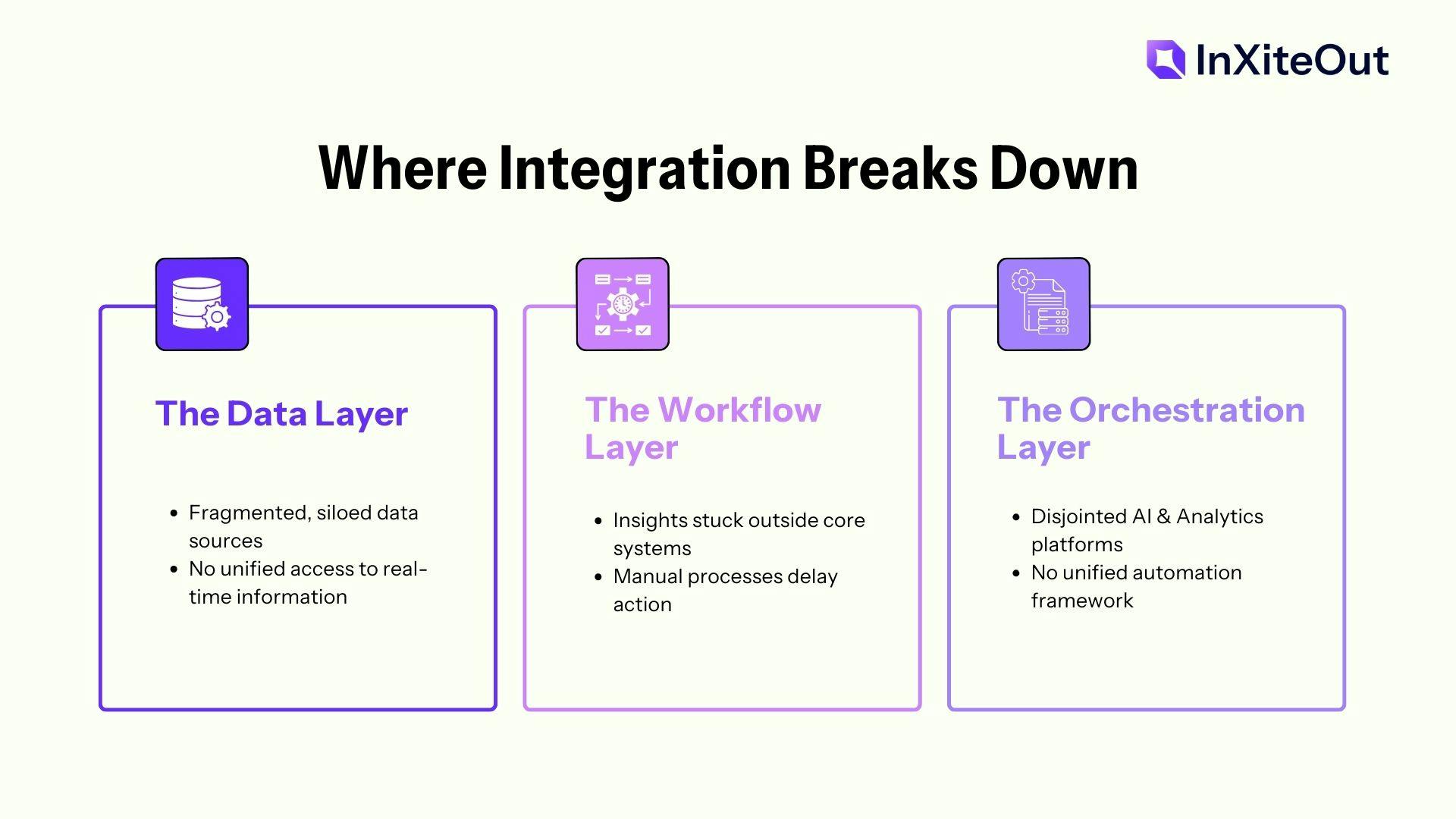
Integration challenges emerge across three layers of the enterprise technology stack.
The Data Layer
GenAI systems need access to unified, current, and governed enterprise data — customer histories, product telemetry, operational metrics, internal knowledge. In most enterprises, this data is fragmented across CRM platforms, ERP systems, support tools, and analytics environments that were never designed to interoperate. Without a unified data foundation, GenAI outputs lack the context needed to be reliable or actionable.
The Workflow Layer
Even when GenAI produces accurate insights, they frequently don’t reach the people or systems that need to act on them. A churn prediction that isn’t surfaced inside the CRM won’t trigger a retention workflow. A sales signal buried in a weekly report won’t change rep behavior in time to matter. Integration at the workflow layer is what converts insight into action.
The Orchestration Layer
Most enterprises have accumulated a diverse stack of analytics, ML, and GenAI tools that don’t talk to each other. Without an enterprise AI orchestration architecture, a unified layer connecting data pipelines, models, and business systems, AI remains a collection of isolated capabilities rather than a coherent intelligence layer.
Where Does Your Organization Stand? A Maturity Diagnostic
Before investing further in GenAI, leadership teams should assess their integration maturity. Most enterprises fall into one of four stages:
Stage 1 — Isolated Tools: GenAI operate as standalone assistants. Outputs are manually transferred to business systems. ROI is limited to individual productivity gains.
Stage 2 — Data-Connected: GenAI has access to enterprise data via APIs or data platforms, but outputs still require human interpretation and manual workflow integration.
Stage 3 — Workflow-Embedded: GenAI is integrated into operational systems (CRM, ERP, ITSM) and surfaces insights directly where decisions are made. Automation is partial.
Stage 4 — Orchestrated AI Ecosystem: A unified orchestration layer connects data, models, guardrails, and workflows end-to-end. GenAI triggers automated actions, adapts to new data in real time, and scales across functions without manual intervention.
Most enterprises today sit at Stage 1 or 2. The gap between Stage 2 and Stage 4 is almost entirely an integration problem.
Quick self-diagnostic: If your team copies AI outputs into spreadsheets before acting on them, you’re probably at Stage 1. If your GenAI system can’t access data updated in the last 48 hours, you’re at Stage 2. If AI insights regularly go unacted upon because they live outside operational workflows, the integration tax is already compounding.
What Integration Looks Like in Practice
Organizations that achieve strong GenAI ROI treat integration as a first-class architectural requirement, not a post-deployment consideration. In practice, that means building across four components:
Unified data foundation: A governed data platform that gives GenAI systems consistent access to real-time, trusted enterprise data, eliminating context gaps that degrade output quality and erode business trust.
Workflow-embedded intelligence: GenAI outputs delivered directly inside operational systems — the CRM, the support console, the internal knowledge portal — so insights drive action without manual handoff.
Enterprise AI orchestration: An architecture layer that connects data pipelines, AI models, and business systems, enabling automated decision-making and execution within defined guardrails.
Integrated governance: Safety and compliance guardrails built into the architecture from day one so AI can operate at scale without introducing new risk.
Two Enterprise Deployments That Demonstrate the Difference
Use case 1:
A global enterprise faced this challenge in its sales organization. Thousands of weekly sales conversations generated valuable signals on customer intent and buying readiness — but those signals remained locked in unstructured data, disconnected from sales workflows.
We deployed an integrated GenAI-powered sales intelligence platform, which analyzed over 20,000 minutes of conversation data automatically each week. Valuable insights and signals were embedded directly into CRM workflows, enabling teams to prioritize opportunities and act in hours rather than days — transforming GenAI from a passive analysis tool into an operational sales capability. [Read the full case study.]
Use case 2:
InXiteOut helped an enterprise design and deploy a GenAI assistant, integrated with continuously updated company documents, HR workflows, and IT support processes. Employees received accurate, contextual answers from the assistant in real time. The outcome was a 15% reduction in HR and IT support tickets, plus a measurable improvement in operational efficiency. [Read the full case study.]
In both cases, the model wasn’t the differentiator. The integration architecture was.
Why This Keeps Getting Deprioritized
Despite the cost, integration consistently gets deferred. Three dynamics explain why.
- The pilot mentality: Most GenAI initiatives start as departmental experiments focused on quick wins. Integration with enterprise systems is treated as a “Phase 2” problem, which often means it never gets properly resourced, leading to a thriving demo environment that has never touched a production workflow.
- Legacy complexity: Enterprise environments are built on decades of accumulated systems, fragmented data ownership, and organizational silos. Integration feels expensive and slow compared to deploying another AI tool.
- Model-over-architecture bias: Organizations often invest heavily in model selection while underestimating the architectural work needed to make those models operationally useful at scale. As a result, businesses are often left with a growing inventory of GenAI capabilities that generate modest business impact.
The Strategic Imperative
Generative AI has genuine potential to reshape enterprise operations, but that potential is only realizable through an integration infrastructure that allows models to access live enterprise data, embed in operational workflows, and drive automated action at scale.
The diagnostic question every enterprise leader should be asking is not “Do we have GenAI deployed?” — it’s “At what point in our AI workflow does intelligence stop and manual handoff begin?”
That handoff point is where ROI is being lost. Closing it is the strategic imperative.
Generative AI creates intelligence. Integration ensures that intelligence drives outcomes.
Author

Read More

AI in Retail: How Leading Brands Use AI for Customer Segmentation and Personalization
Discover how AI is redefining retail by making customer segmentation and personalization more dynamic, data-driven, and scalable than ever before.

Customer Segmentation Models and How AI is Enhancing Them
Explore 8 customer segmentation models — from RFM and behavioral to psychographic and AI-powered — with real brand examples and how AI makes segmentation smarter.

Data Mesh vs. Data Fabric: Key Differences, Use Cases, and How to Choose
Explore how data mesh and data fabric compare in modern data architecture. Learn which approach suits your business needs, supports AI readiness, and helps you implement scalable, secure data strategies.
Sign up for our newsletter
Don't miss our latest AI & Analytics updates
We respect your privacy. Unsubscribe at any time.