Share this Blog
Governance-First AI: Why Databricks Unity Catalog Should Come Before Your First AI Agent
In most enterprise Agentic AI rollouts, governance is bolted on after the build instead of being designed into the foundation from the start. It might look like a simple sequencing decision, but in reality it can create architectural, security, and scalability constraints that become increasingly expensive to fix downstream.
On Databricks, this governance foundation is provided by Unity Catalog. It is not a nice-to-have feature layered on top of the Lakehouse; it is the control plane for governing data and AI assets.
This blog presents a point of view shaped by what we have seen work across real-world Databricks engagements. It explores why retrofitting governance can undermine solutions, what “governance-first” means in practice, and how to put a minimum viable Unity Catalog foundation in place before the first Agentic AI use case is deployed.
What is Unity Catalog?
At its core, Databricks Unity Catalog is a unified governance layer that sits beneath everything you do with data and AI on Databricks across AWS, Azure, and GCP. It is a key component of an organization's overall enterprise AI governance framework.
Unity Catalog organizes securable objects within a three-level catalog–schema–object hierarchy, with different object types representing data, models, functions, agents, MCP services, and other governed assets.
This object model gives organizations a consistent way to define, manage, and audit access across data and AI assets. At the foundational layer, an account-level metastore anchors identity, access control, lineage, and audit logging in one place. You work with it through Catalog Explorer, SQL, the CLI, or REST APIs.
Unity Gateway sits on top of Unity Catalog as the runtime enforcement layer, evaluating every model call and tool invocation against policy before execution.
Databricks began enabling Unity Catalog automatically on new workspaces from November 2023, which means many organizations using Databricks already have it running, even if they have not configured it deliberately.
Governance-First AI Architecture with Unity Catalog
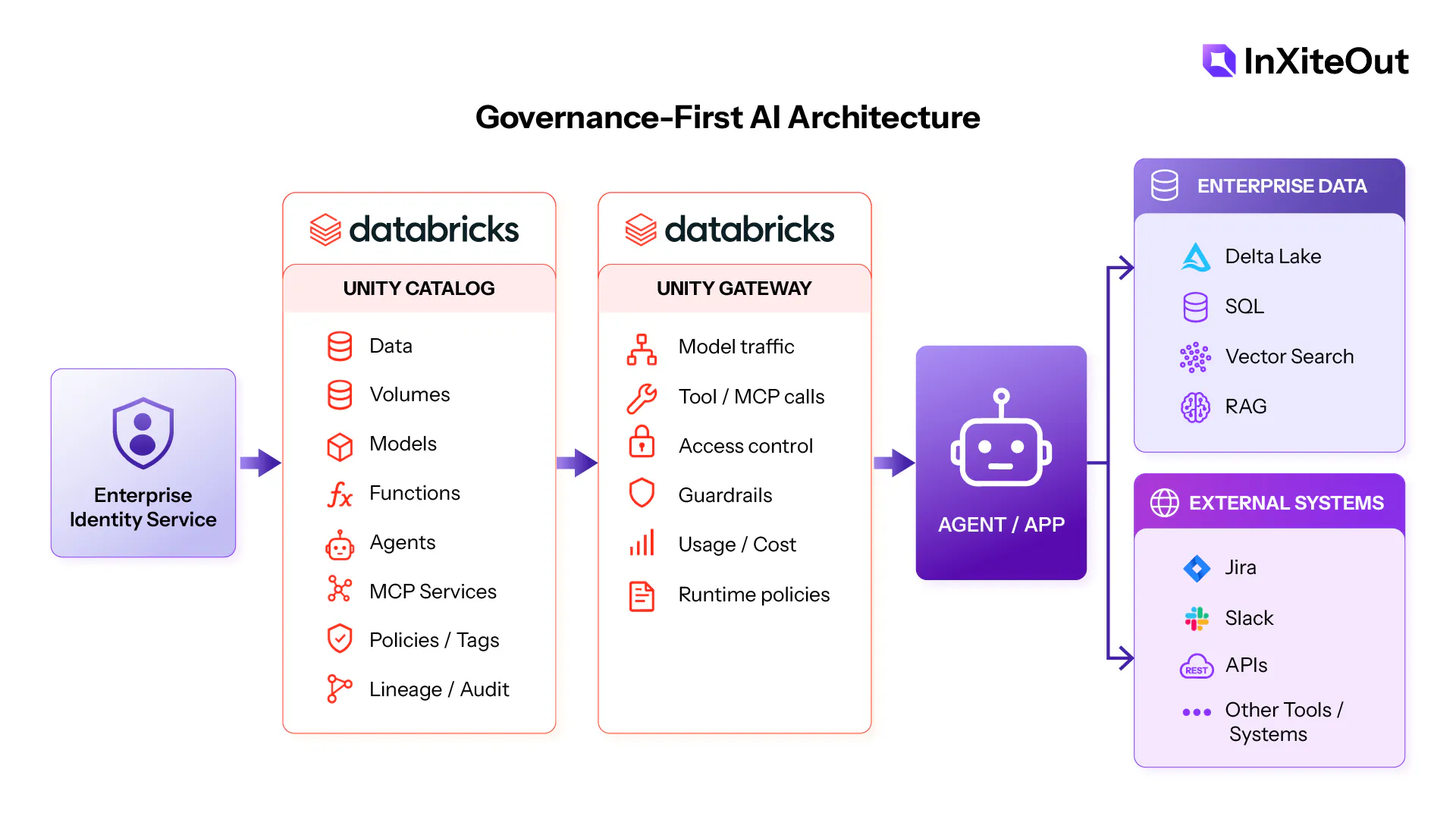
The diagram below shows an enterprise AI governance framework on Databricks. Source data and AI assets get registered in Unity Catalog, where access control, lineage, audit, and classification apply uniformly. Unity Gateway then enforces those policies at runtime for every model, agent, and tool call, and only then can an Agentic AI application or a business user reach enterprise data or external systems.
Why Agentic AI Breaks Retrofit Governance
Retrofit governance, meaning adding the controls after the solution is designed, is not a sound approach to an enterprise AI governance framework. With Agentic AI, the cost of retrofitting governance can become extremely high. The three most common reasons retrofitting falls short for Agentic AI are:
High impact radius
A typical dashboard query reads from a known, fixed set of tables. But an agent might call an LLM, retrieve from a vector index, hit an MCP server connected to Jira or Slack, and write back to a ticketing system — all in one user turn. If you're governing table access but not model and tool access, you've covered only a fraction of the actual surface area.
Unclear user identity
In a lot of early Agentic AI builds, the agent runs under a shared service account, which means every action it takes looks identical in the logs, regardless of which employee actually triggered it. While it may work in a demo environment, it becomes a real problem in production. When something goes wrong, an incident review cannot trace an action back to the person who triggered it, because every request carries the same service account identity.
Costly rework after launch
Once a use case is live and employees start using it, changing the access model underneath it means renegotiating trust with users who've already built habits around the tool. We've watched teams spend more time walking back an ungoverned pilot than it would have taken to govern it properly from day one.
Agentic AI collapses several previously separate concerns, such as data access, model access, tool access, and orchestration into a single conversational interface, so getting governance right from the start becomes the cornerstone of every implementation.
What “Governance-First” Actually Means (and What It Doesn't)
Many organizations see governance-first as just one of several possible approaches, rather than a prerequisite for Agentic AI. Others go to the opposite extreme and turn governance into a six-month platform project. Both miss the point.
Governance-first means that, before you build the first use case, you establish the identity model, the catalog structure, and the access and audit mechanics that every subsequent use case will inherit. Instead of governing the agent, you're governing the platform the agent runs on. Once this foundation is in place for the first use case, subsequent use cases inherit it instead of needing a governance framework of their own.
Governance-first does not mean locking every table behind an approval workflow or building a perfect taxonomy before anyone is allowed to query. We have seen governance-first initiatives stall for months chasing a “complete” catalog structure that would have been perfectly fine at 80%.
The honest framing for governance-first AI is closer to a minimum viable foundation than a finished governance program. You need enough structure so that access control, lineage, and audit are switched on and consistent, but not a fully mature data mesh with every domain modeled to perfection on the first day. The rest should evolve alongside your use cases.
The Minimum Unity Catalog Foundation You Need Before Use Case #1
This is the sequence we actually follow for Unity Catalog implementation. It is designed to make your enterprise AI governance framework safe and auditable from the very beginning. You may treat it as a checklist for your project.
Step 1: Confirm the Metastore and Get Identity Right
If your workspace was created after November 2023, Databricks Unity Catalog is most likely already enabled. Confirm the metastore is attached and set up correctly. Then make sure account-level identity is configured correctly. Unity Catalog permissions are generally granted to:
- Account-level users
- Service principals
- Account-level groups
Every downstream capability, including on-behalf-of token passing for agents, depends on identity being modeled correctly at the account level. As a best practice, grant privileges to groups rather than individual users, so access follows role changes automatically.
Step 2: Design Catalogs Around Domains
A catalog is the primary unit of data organization in Databricks Unity Catalog. Catalogs mapped to the current org chart often become problematic over time, because teams reorganize, but catalogs remain unchanged.
We generally recommend structuring catalogs around durable boundaries such as business domain, environment (dev/staging/prod), or sensitivity tier, with schemas providing the finer-grained structure underneath. The two most common mistakes we see in catalog design:
- One catalog per team, which creates sprawl that nobody can navigate.
- One giant catalog for everything, which results in a permissions model that is technically unified but practically useless.
Step 3: Bring Data Under Managed Governance
Managed tables and volumes allow Databricks to manage the underlying storage lifecycle within Unity Catalog's managed-storage model. External tables and volumes allow organizations to retain ownership and management of the underlying cloud storage while still applying Unity Catalog governance.
For Agentic AI specifically, this step includes the unstructured documents (PDFs, transcripts, knowledge base exports) feeding the retrieval pipeline. If these documents live in a volume registered in Unity Catalog, they inherit the same access control and audit trail as the tables.
Step 4: Turn On Lineage, Audit Logging and Classification by Default
Unity Catalog's column-level lineage is automatic; no manual tagging is required. In our experience, it is the most useful capability when an Agentic AI answer looks wrong and the user needs to know why. Pair it with system tables for queryable audit logs, and AI-assisted data classification to flag PII and sensitive fields before they are embedded in a vector index.
Step 5: Register AI Services, Agents, Models and Tools as Governed Assets
This is the newer, Agentic AI-specific part. Models (both Databricks-hosted and external), agents, MCP services, and skills can now sit in Unity Catalog alongside your tables, with the same discovery, permissions, and audit trail.
These assets use the same three-level namespace and the same grant and revoke mechanics you already use for tables. Agents can be registered as Agent Services, while model endpoints, external model providers, MCP services, functions, and other tools can be governed as their respective Unity Catalog securable objects.
Step 6: Add Unity Gateway in Front of Every Model and Tool Call
Unity Gateway is the runtime enforcement layer built on Databricks Unity Catalog. It evaluates every model call, tool invocation, and agent interaction against policy before execution, and logs the action. Identity is carried through on-behalf-of token passing, so agents inherit the invoking user's actual data permissions in real time.
If a user can't access a table, neither can an agent acting on their behalf. Every action gets logged against both identities, the real user and the acting agent, which makes incident review straightforward. Contextual service policies add one more layer, letting admins allow, deny, or require approval for specific actions.
Step 7: Pilot Use Case #1 Against This Foundation
Once the first six steps of Unity Catalog implementation are in place, the first use case becomes a validation exercise for the platform, not just a one-off build. The team shipping the chatbot or agent shouldn't need to think about access control, lineage, or audit; these should already be in place, inherited from the catalog and gateway configuration underneath.
A Quick Governance-First Readiness Check
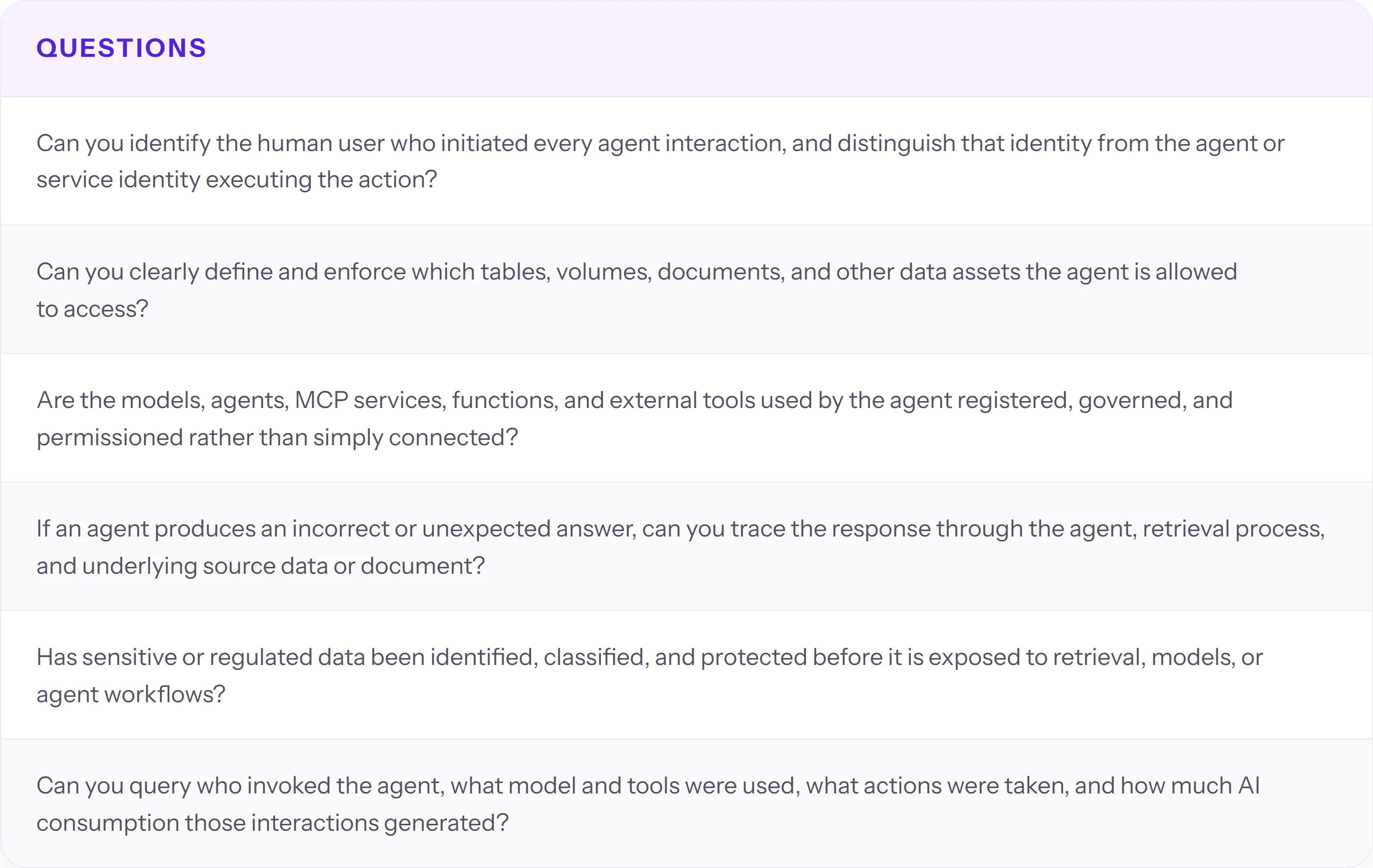
Before you go ahead with the first Agentic AI use case, answer these six questions. Each one maps to a part of the foundation above, so any answer that is not a clear “yes” points to the gap you should close first.
Frequently Asked Questions
1. What is Unity Catalog in Databricks?
Unity Catalog is Databricks' unified governance layer for data and AI. It provides a single place to manage access control, lineage, auditing, and discovery across workspaces and asset types such as tables, volumes, files, functions, ML models, agents, and MCP services. Tables, models, agents, and other assets are modeled as securable objects and addressed through a three-level namespace (catalog, schema, object). Databricks has enabled Unity Catalog automatically on most new workspaces since November 2023.
2. Is Unity Catalog required for Agentic AI on Databricks?
Technically, you can build an Agentic AI proof of concept without Unity Catalog. For production, however, it should be a foundation to prevent Agentic Sprawl — multiple agents, models, tools, and identities with fragmented governance. Unity Catalog and Unity Gateway provide a common framework to govern and scale these AI workloads.
3. How long does a Unity Catalog implementation take?
It depends heavily on your starting point. If Unity Catalog is already enabled, establishing the minimum viable foundation (identity, catalog structure, managed data, lineage and audit, and AI asset registration) typically takes a few weeks for a focused team. However, migrating a large legacy Hive Metastore estate or untangling years of ungoverned workspace sprawl can extend the timeline considerably. With Crucible, our Agentic ETL Accelerator, we can implement a governed, UC-enabled data foundation in 40% less time.
4. What's the difference between Unity Catalog and Hive Metastore?
Hive Metastore is workspace-scoped, limited to tables and views, and offers only limited, legacy table access controls, with no native lineage or AI asset governance. Permissions are typically managed at the storage layer, which is coarse and hard to audit. Unity Catalog is account-level, shared across all workspaces in a region, and governs a much broader object model (tables, volumes, models, agents, MCP services) through a consistent three-level namespace with built-in lineage, audit logging, and fine-grained, attribute-based access control. Workspaces still on Hive Metastore should treat migration as a prerequisite to any serious Agentic AI initiative.
5. Does Unity Catalog govern AI models and agents, or just data?
Both. Since the 2026 platform expansion, models (Databricks-hosted and external), agents, MCP services, and skills are governed with the same permissions, lineage, and audit framework as tables and volumes. Unity Gateway sits on top as the runtime enforcement layer, evaluating every model call, tool invocation, and agent interaction against Unity Catalog policy before it executes. Identity flows end to end via on-behalf-of token passing.
6. How can Unity Catalog help control the cost of Agentic AI deployments?
Agentic AI can increase costs quickly as agents make multiple model calls, retrieval queries, and tool invocations. Unity Gateway gives a single view of AI spend across model providers, attributes costs to users, teams, and use cases, and lets admins set budget alerts and hard spend caps. Because it is built on Unity Catalog, these controls follow the same identities and permissions as the rest of the platform. This helps prevent uncontrolled AI spending as Agentic AI adoption scales.
The Takeaway
A governance-first approach means your Agentic AI solutions don’t have to be rebuilt every time a new regulation, audit, or security review lands. The organizations getting real, compounding value by building Agentic AI solutions on Databricks are the ones where the second use case took a fraction of the effort of the first, because the identity model, the catalog structure, and the access and audit mechanics were already in place to reuse.
Unity Catalog and Unity Gateway give you the mechanics to build a strong enterprise AI governance framework. Implement them the right way, and your first Agentic AI project will become the proof point that justifies investing in the next.
For years, we have helped leading organizations build a robust data foundation on Databricks and deliver AI solutions with clear ROI. If you’re not sure how best to approach Databricks Unity Catalog implementation or AI governance in your organization, our team of experts can help you chart the right roadmap and put it into practice. Send us a request for a quick discovery call.
References
1. Databricks — What is Unity Catalog?
2. Databricks — Data and AI governance with Unity Catalog
3. Databricks Blog — What's new with Unity Catalog at Data + AI Summit 2026
4. Databricks — Unity Catalog product page
Author

Read More

AI in Retail: How Leading Brands Use AI for Customer Segmentation and Personalization
Discover how AI is redefining retail by making customer segmentation and personalization more dynamic, data-driven, and scalable than ever before.

Customer Segmentation Models and How AI is Enhancing Them
Explore 8 customer segmentation models — from RFM and behavioral to psychographic and AI-powered — with real brand examples and how AI makes segmentation smarter.

Data Mesh vs. Data Fabric: Key Differences, Use Cases, and How to Choose
Explore how data mesh and data fabric compare in modern data architecture. Learn which approach suits your business needs, supports AI readiness, and helps you implement scalable, secure data strategies.
Sign up for our newsletter
Don't miss our latest AI & Analytics updates
We respect your privacy. Unsubscribe at any time.